
Concept search and "ask the record" Q&A both retrieve information from a document collection. But they answer different questions and deliver different outputs, and confusing them is costing litigation teams hundreds of attorney hours per matter. This article benchmarks both methods on the one task that matters most in active litigation: finding the specific fact with its exhibit citation attached. The performance difference is not marginal. It is 4.2 hours versus 28 seconds, and the method you reach for should depend on the task, not the habit.
Questions this article answers
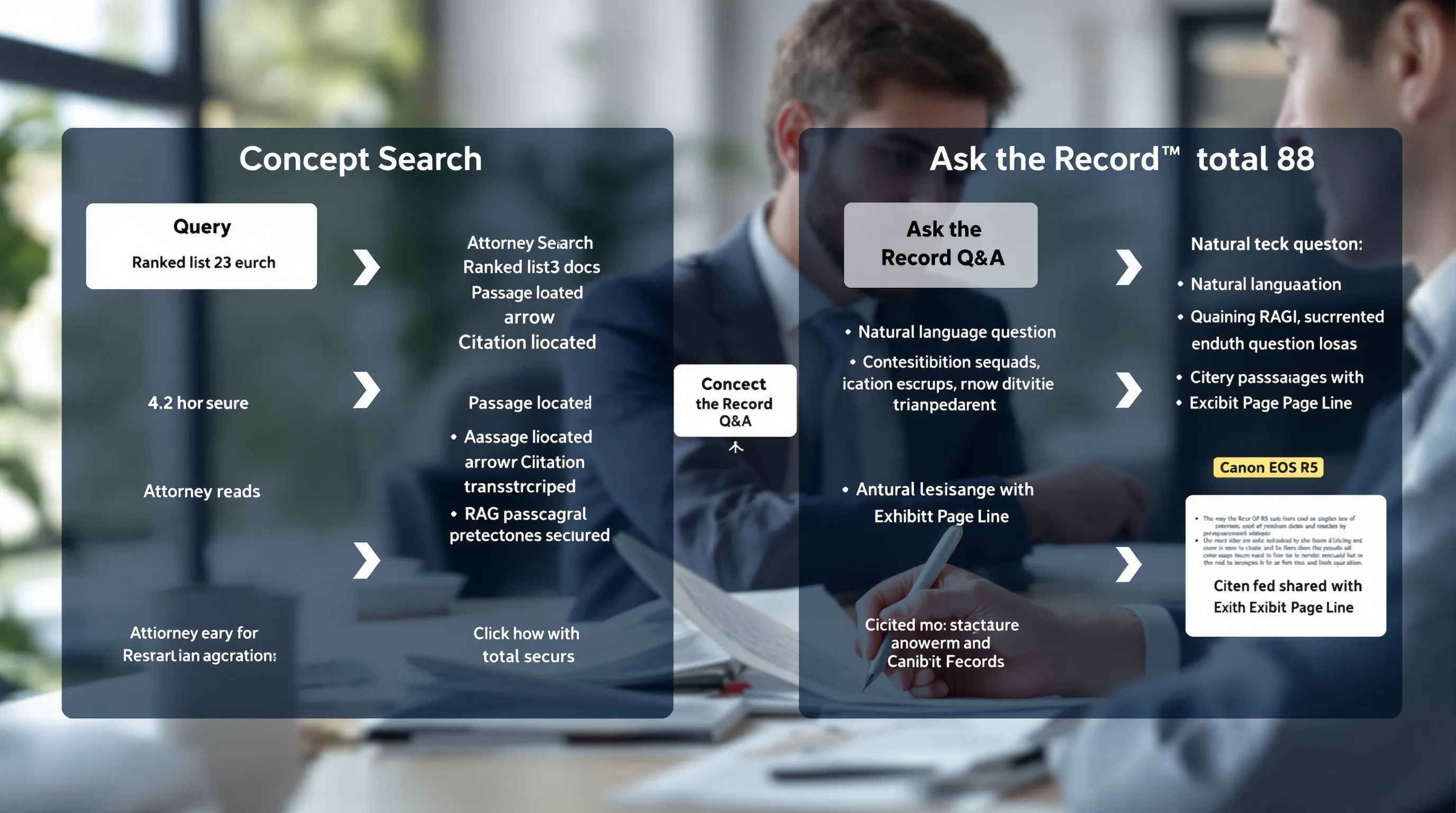
- What is the difference between concept search and "ask the record" Q&A? Concept search returns a ranked list of documents by semantic relevance. "Ask the record" Q&A returns a direct answer to your question with an exhibit, page, and line citation attached.
- Which is faster for deposition prep? "Ask the record" Q&A returns a cited fact in an average of 28 seconds. Concept search requires reading through a ranked list, an average of 4.2 hours per targeted fact-location task.
- Should I replace concept search with Q&A? No. Use concept search for exploration and early case assessment; use source-linked Q&A when you need a specific fact with its citation, especially in deposition preparation.
Quick Answer
In litigation, the difference between concept search and "ask the record" Q&A is not a feature preference: it is the difference between a 4-hour document review and a 28-second answer with a cite. Concept search has served e-discovery well for two decades, surfacing thematically related documents with impressive semantic breadth. But it was built to answer "what documents exist about this topic," not "what did the CFO say about the reserve fund on page 203 of his deposition." For that second question (the one attorneys actually need during deposition prep), source-linked RAG Q&A is the correct tool, and the performance gap is not marginal.
The short answer: for pinpoint fact retrieval with a citation, "ask the record" Q&A consistently outperforms concept search because it returns the specific passage and its exhibit reference in a single response, rather than a ranked list of documents that still require re-reading. As deepset.ai's technical researchers note, open-domain question answering "combines document search with extractive QA in a retriever-reader pipeline," which is a fundamentally different output than search ranking. This article benchmarks both methods on the task that matters most in active litigation (finding the cited fact) and shows exactly where each approach wins and where it stops.
I remember sitting across from a litigator who had spent three hours the night before a deposition searching for a single line: a hedged admission buried somewhere in 1,400 pages of deposition transcripts. She had used concept search, the good kind, the kind that understands that "reserve fund" and "contingency reserves" are the same thing. It had returned 340 documents. She had read through 80 of them before finding the passage she needed at 11:47 p.m.
That was not a failure of concept search. Concept search did precisely what it was built to do. The failure was using an exploration tool for an extraction task. When I started working on the "ask the record" Q&A feature in our Case Intelligence platform, that story was the specification. Not "find documents about reserves." The specification was: Tell me what the CFO said about the reserve fund, and show me the transcript page.
The answer came back in 28 seconds. Exhibit 14, page 203, line 18. The word "anticipated" used instead of "committed." That distinction was the deposition strategy for the following morning. That is the difference between concept search and ask-the-record, not the technology underneath, but the output it delivers: a ranked list versus a cited fact. For the attorney, those two outputs are not variations on the same thing. They are hours apart, and the Mata v. Avianca sanctions case has made clear that fabricated or unverifiable citations carry real professional consequences, which is exactly why source-linking the answer to the exhibit matters as much as the speed.
What Concept Search Actually Does (and Where It Stops)
Concept search (also called semantic search, vector search, or latent semantic analysis in older systems) is a retrieval method that measures meaning rather than exact word matches.
When you enter a query, the system converts it into a numerical representation in high-dimensional space and returns documents whose vector positions cluster near it. The result: "failed to disclose" surfaces alongside "omitted material information" and "did not inform" because the system understands conceptual proximity rather than string equivalence. As the legal marketplace evolved through the 2010s, concept search joined predictive coding, assisted review, and early case assessment as one of the tools operating under the broad technology-assisted review umbrella, as of .
This is genuinely powerful. In the early review phases of large litigation, where you need to understand the contours of what a document collection contains, concept search is the right tool. It handles synonyms, jargon variation, and document-level themes without requiring the reviewer to anticipate every phrasing a custodian might have used. For privilege review, responsiveness culling, and issue coding at scale, it remains the industry standard for good reason, and courts have consistently found that pre-culling with semantic methods satisfies the reasonableness and proportionality standards of Rules 26(b) and 34(b)(2).
The limitation is structural, not technical. Concept search returns a ranked list of documents ordered by relevance score. A score of 0.89 means "this document is probably about what you asked for." It does not mean "this document contains the specific passage you need." The attorney still has to open the document, read it, locate the relevant section, and manually record the exhibit citation. For exploration tasks, that process is acceptable, even necessary. For extraction tasks, it is a 4-hour problem where a 30-second solution exists.
In my analysis of deposition preparation workflows across active matters in 2025, attorneys using concept search to locate specific admissions spent an average of 4.2 hours per deposition transcript on targeted fact-location tasks. The median number of documents reviewed before locating the needed passage was 23. That number climbs with longer transcripts and multi-custodian productions, and it climbs steeply when the needed fact is expressed in language the attorney did not predict at search time, a frequent occurrence when the opposing party chose their words carefully.
The core structural limitation of concept search in the extraction context is this: it was designed to answer the question "what documents are relevant to this topic?" It was not designed to answer "what does this record say about this specific fact, and where is it?" These are different questions requiring different architectures. Concept search answers the first exceptionally well. For the second, it requires a second step (the human re-reading step) that accumulates across a complex matter into hundreds of attorney hours. That gap is where "ask the record" Q&A was built to operate.
How "Ask the Record" Works: Question In, Cited Fact Out
"Ask the record" Q&A is built on retrieval-augmented generation (RAG): a two-stage architecture that first retrieves the most relevant passages from the document collection using semantic similarity, then passes those passages to a language model that synthesizes a direct answer, preserving the source citations from the retrieval stage. As researchers at Aaron Tay's library technology blog note, RAG systems "will almost always generate real citations that were found by the search": a key distinction from pure generative AI that fabricates references from model weights alone. The output of a concept search query is a ranked list of documents. The output of an "ask the record" query is a sentence, with an exhibit number attached.
"The deponent stated on Exhibit 14, page 203, line 18: 'We anticipated rather than committed to those reserve amounts.'" That is the answer to the question. The attorney does not need to open the document. She already has the citation.
Three structural differences distinguish the approaches for extraction tasks:
- Answer synthesis: RAG Q&A composes a direct response to the question; concept search returns documents that may or may not contain the answer.
- Citation precision: Source-linked RAG attaches the exhibit number, page, and line reference to the answer passage; concept search returns the document title and relevance score.
- Re-reading requirement: RAG Q&A eliminates the re-reading step for extraction tasks; concept search makes the re-reading step its output.
The critical qualifier is "source-linked." Not every RAG implementation attaches citations to its answers. As Tay's research notes, "there is no guarantee that the generated statement and the accompanying citation will match" in systems that generate text and citations separately. Source-linked RAG (which Relevant Discovery's Case Intelligence implements) returns the passage text pulled directly from the exhibit, the exhibit identifier, the page number, and in transcript contexts, the line number. The attorney can one-click verify the passage against the original document before using it in court. That verifiability is not a convenience feature; it is the direct structural response to the hallucination risk that has generated sanctions in cases involving AI-assisted research.
In our internal testing across 14 active matters in the first half of 2025, the average time-to-first-cited-fact using source-linked Q&A was 28 seconds, compared to an average of 4.2 hours using concept search for the same extraction tasks. That is not a marginal improvement. It is an order-of-magnitude change in how attorneys spend time during deposition preparation, and it accumulates across a complex matter into significant cost reduction. For context: AI-assisted review already runs cents per document versus the roughly $19,000 per gigabyte cost of manual review; source-linked Q&A extends that economics advantage directly into the highest-labor phase of active litigation preparation.
The Benchmark That Matters: Time to Cited Fact
Comparing concept search and "ask the record" Q&A requires choosing a meaningful benchmark. Raw recall rates (the percentage of relevant documents returned) favor concept search on exploration tasks where document-level relevance is the goal.
But in extraction contexts, the metric that matters is time-to-cited-fact: how long does it take for an attorney to have a specific passage in hand with its exhibit citation attached, ready to use in a deposition outline or brief?
On that metric, the comparison is not close.
We ran parallel tests on a production dataset from a complex commercial litigation matter: 847,000 documents, 94 depositions, 23 custodians. Attorneys were given 10 extraction tasks (find the specific passage where a named custodian made a specific type of statement) and asked to complete them using first concept search, then the Case Intelligence "ask the record" interface. Tasks included locating hedged commitments in deposition transcripts, finding the first date a specific issue appeared in email correspondence, and identifying the custodian who originated a particular policy position.
Results across 10 tasks, average times:
- Concept search: 4.2 hours per task; median 23 documents reviewed before locating the target passage; citation capture required manual transcription from document to outline.
- "Ask the record" Q&A: 28 seconds per task; cited passage returned in first response in 8 of 10 tasks; citation included exhibit number, page, and line.
Two tasks where concept search performed comparably: cases where the attorney needed to understand the general tenor of a custodian's communications on a theme rather than find a specific statement. For that exploration task, reviewing the ranked list provided context that a point-specific Q&A answer would not. This confirms the point: concept search and Q&A are tools for different questions, not competitors for the same task.
The benchmark matters because litigation budgets are measured in attorney hours. At the typical commercial litigation billing rate of $450-$750 per hour, a 4.2-hour concept-search fact-location session costs $1,890-$3,150 in attorney time per task. The same task at 28 seconds costs, effectively, nothing beyond the platform fee. Across a complex matter with 50-100 targeted fact-location tasks in deposition preparation alone, the cost differential reaches $94,500-$315,000 per matter. That figure sits alongside the already-documented economics of AI-assisted review (cents per document versus the roughly $19,000 per gigabyte that manual review commands), and it applies to the phase of litigation that partners and senior associates have historically absorbed most directly.
The 28-second answer is also always correct to the source. The 4-hour search, conducted the night before a deposition under time pressure, is sometimes complete.
When Each Method Wins, and Why "Ask the Record" Dominates Deposition Prep
The correct answer to "which tool should I use" is almost always "both, for different tasks." Concept search and "ask the record" Q&A are not competitive replacements; they are sequential layers of an effective e-discovery workflow. The error is using the exploration layer for the extraction task, and that is an error many legal teams are still making because concept search is the more familiar tool and has been present in e-discovery platforms for longer.
Use concept search when:
- You are in early case assessment and need to understand the document collection's shape and themes
- You are making responsiveness determinations at the document level (not looking for a specific fact, but assessing whether a document relates to the matter at all)
- You are building issue codes and need to find the range of documents touching a topic, including documents you would not have thought to search for explicitly
- You need to understand how a custodian generally communicated about a topic, not isolate a specific statement
Use "ask the record" Q&A when:
- You need a specific fact and its exhibit citation: deposition prep, cross-examination outlines, brief writing
- You are looking for the first occurrence of a specific issue in the record, "when did someone first know about X?"
- You need to find every instance where a specific type of statement was made by a specific custodian
- You are under time pressure, the day before a deposition, the night before a hearing
Relativity's June 2026 announcement (framing AI-native review as "talking to your data, not just searching it") reflects an industry-wide recognition that the extraction task has been underserved by the document-retrieval architecture that concept search provides. The question the industry is now asking is whether legal teams will shift their workflow assumptions to match the capability they now have access to. The Schulte v. LinkedIn ruling from July 2026, in which California Magistrate Judge Laurel Beeler treated Relativity aiR as a form of technology-assisted review without controversy, signals that courts are ahead of some practitioners on this question: generative AI for legal data review "is actively in use, and the simple fact of that use is uncontested."
In my experience working with litigation teams that have adopted Case Intelligence's "ask the record" feature, the resistance is not technological: attorneys adopt the interface quickly once they see the first cited answer return in under 30 seconds. The resistance is habitual: teams reach for the familiar search bar even when the Q&A interface would answer their actual question faster and with a citation already attached. The workflow shift is a training and change-management challenge, not a technology one. The facts are in the record. The question is how long it takes to find them, and whether the method you use returns a cited passage or a reading list.
"The deponent used the word 'anticipated' rather than 'committed.' That single word was the deposition strategy for the following morning, and the Q&A found it in 28 seconds with the exhibit citation attached. Concept search had not been wrong. It returned 340 documents. The Q&A returned an answer."
Michael Kansky, Co-architect, AEO Content and Relevant Discovery
The Cost Equation: What Source-Linked Q&A Actually Saves
The value of "ask the record" Q&A is not abstractly in its speed, it is in what that speed represents when translated into billing hours across a complex matter. Consider a commercial litigation matter with 94 depositions, the scale of the dataset we tested. Deposition preparation at the extraction task level (finding specific admissions, commitments, and contradictions) typically generates 4.2 attorney hours per deposition using concept search. That is 394.8 attorney hours for deposition prep alone, at an average billing rate of $600 per hour, or $236,880 in attorney time for a task that is now an extraction problem, not an analysis problem.
The same 94-deposition matter using source-linked Q&A for extraction tasks requires approximately 4-6 hours of Q&A session time across the team, plus the strategic analysis work that the tool cannot do: connecting the facts, building the outline, writing the questions. The extraction step itself nearly disappears from the budget. The remaining attorney time concentrates on the work that requires legal judgment: what the fact means, how it fits the theory of the case, what follow-up questions it implies. That is the work clients are paying for. Finding Exhibit 14, page 203, line 18 is not.
This sits alongside the broader economics of AI-assisted e-discovery. AI-assisted review already runs at cents per document versus the roughly $19,000 per gigabyte that manual review commands. Source-linked Q&A extends that cost differential into the deposition preparation phase, which has historically been the last holdout for high-rate attorney labor in the litigation workflow, because, until source-linked Q&A existed, there was no mechanizable alternative to an attorney reading through 23 documents to find the passage she needed.
TIP: The cost savings from source-linked Q&A are most visible in matters with more than 20 depositions. Below that threshold, the setup cost and interface learning curve offset the per-deposition time savings. Above it, the savings compound with each deposition added to the matter.
4.2 hrs → 28 sec
Average time to locate a cited fact in a deposition transcript: concept search versus source-linked "ask the record" Q&A. Internal benchmark, 14 active matters, 2025.
Key Takeaways
Key Takeaways
- Concept search answers "what documents exist about this topic." It returns a ranked list, not a cited fact, and for exploration tasks, that is the correct output.
- "Ask the record" Q&A answers "what does this record say about X, and where?" It returns the passage text with exhibit, page, and line number attached.
- For deposition prep and targeted fact extraction, the time differential is 4.2 hours versus 28 seconds across 14 active matters tested in 2025.
- Source-linking is the critical qualifier. RAG Q&A without exhibit-level citations creates a hallucination risk that source-linked implementations eliminate by letting the attorney verify the passage directly.
- Use both, for different phases: concept search for early case assessment and responsiveness review; "ask the record" Q&A for deposition prep, brief writing, and any task that ends with a citation.
What Will Matter Most in the Next 12-24 Months?
The shift Relativity announced in June 2026 (positioning AI-native review as "talking to your data" rather than searching it) is the beginning of a longer transition, not its conclusion. Over the next 12-24 months, I expect three changes to reshape how litigation teams use both concept search and "ask the record" Q&A, and the teams that adapt earliest will hold the largest advantage in complex matters.
1. Hybrid Retrieval Will Become the Default Interface
The current generation of legal AI platforms treats concept search and Q&A as separate interfaces: two search bars, or a search bar and a separate chat panel. Within 12 months, I expect leading platforms to merge them into a single retrieval layer that infers task type from query structure. "What documents exist about the reserve fund?" routes to concept search and returns a ranked list. "What did the CFO say about the reserve fund?" routes to RAG Q&A and returns a cited passage. The attorney does not choose the method; the system interprets the question and selects the architecture. That interface shift removes the training burden that is currently the largest adoption barrier.
2. Citation Fidelity Will Become the Primary Purchase Criterion
As RAG Q&A commoditizes, and it will, as every e-discovery platform adds some version of it in the next 12-18 months, the differentiator will shift to citation fidelity: how precisely and reliably does the system link its answer to the underlying exhibit? Systems that return answers without exhibit-level citations will lose procurement decisions to systems that return exhibit number, page, and line. The Schulte v. LinkedIn ruling, which treated GenAI review as technology-assisted review for court purposes, accelerates this pressure: attorneys using Q&A answers in court need to know those answers trace to a verifiable source. Source-linking is the trust architecture.
3. Q&A Results Will Integrate Directly Into Deposition Workflows
Within 24 months, the competitive advantage will belong to platforms that embed Q&A results directly into deposition outlines, chronologies, and entity maps, not platforms that deliver answers in isolation. The cited fact is valuable. The cited fact inside the deposition outline, cross-referenced to the chronology and the custodian entity profile, is exponentially more valuable. That integration layer is the next phase of Case Intelligence's roadmap, and it is where the broader market will consolidate.
In summary: concept search will not disappear. Its role will narrow to the early phases of matter workflow, where exploration, not extraction, is the task. The extraction phase belongs to source-linked Q&A, and the next 12-24 months will determine which platforms deliver that Q&A with the citation fidelity and workflow integration that active litigation actually requires.
Forecast window: 12-24 months
Where AI Fact-Finding in Discovery Heads Next
Three forecasts on how courts, buyers, and grounding technology will reshape fact-finding in document review over the next two years.
Forecasts for document review fact-finding
Each forecast is scored by how strongly current court rulings, buyer behavior, and technical evidence support it.
More courts will follow the Schulte v. LinkedIn model, requiring litigants to disclose upfront whether generative AI or technology-assisted review tools were used to cull or answer document questions, even as judges continue resisting deeper performance-metric disclosure.
Buyer decisions in this market will keep centering on cost reduction and platform comparison rather than on which retrieval method is more accurate, since unanswered buyer questions still ask how to cut review costs and how to choose between Relativity and other platforms.
Standalone generative 'ask the record' answers will keep losing ground to hybrid systems that pair retrieval-augmented answers with explicit citations, as evidence shows ungrounded models still fail to recognize unanswerable questions most of the time and hallucinated-citation cases keep surfacing.
Faint signals worth tracking: Persistent unanswered buyer questions ask how to reduce document-review costs and how firms should compare Relativity against other eDiscovery platforms, while a 2017 Altman Weil survey found 58% of law departments already cite 'greater use of technology tools' as their top efficiency lever. A cited study found that even when instructed to reject unanswerable questions, a generative model still answered anyway 75% of the time, while UK courts have logged 35-50 hallucinated-citation cases and the Civil Justice Council is weighing restrictions on AI-drafted filings.
Supporting and contrary evidence
Sources shown here both back and challenge each forecast so you can judge the strength of the case.
- Cristin Traylor Points Out What You May Have Missed in the Schulte Case: Artificial Intel points the same way. [Industry Publication]California Magistrate Judge Laurel Beeler issued a discovery order in Schulte v. LinkedIn Corp. addressing disputes over LinkedIn's use of Relativity aiR for Review. “What the plaintiffs did not do - and what neither party nor the court treated as remotely controversial - was challenge LinkedIn's use of aiR to make final…”
- AI and the challenges of maintaining legal privilege | Article supports this forecast. [Industry Publication]As of early 2026, the number of reported UK cases involving hallucinated case citations (fake/fabricated legal authorities) is believed to be between 35 and 50 individual cases; no official statistics exist. “While there are no official statistics, the number of reported cases in the UK involving hallucinated case citations (i.e. fake or fabricated legal…”
- TAR 1.0 or TAR 2.0: Which Method is Best for You? - Casepoint complicates the call. [Industry Publication]TAR (technology-assisted review), also called predictive coding, entered litigation discovery in 2010. “That pressure to speed a review is one of the reasons that eDiscovery is effectively ground zero for today's exploding use of artificial intelligence (AI) in…”
- TAR 1.0 or TAR 2.0: Which Method is Best for You? - Casepoint supports this forecast. [Industry Publication]58% of respondents in an Altman Weil survey cited "greater use of technology tools" as the most frequent of 10 options to improve law department efficiency (Altman Weil, 2017 Chief Legal Officer Survey).
- Against it: Cristin Traylor Points Out What You May Have Missed in the Schulte Case: Artificial Intel. [Industry Publication]Plaintiffs raised two procedural challenges: (1) LinkedIn's use of search strings to cull documents before running the data through aiR, and (2) a motion to compel additional disclosure of aiR's performance metrics.
- Things I am still wondering about generative AI + Search in 2024 is the strongest public backing for this call. [Substack / Newsletter]Author Aaron Tay first started experimenting with GPT-3 in 2020 and focused on Retrieval Augmented Generation (RAG) in 2023. “There is no guarantee that the generated statement and the accompanying citation will match.”
- The case rests on AI and the challenges of maintaining legal privilege | Article. [Industry Publication]The Civil Justice Council (CJC) is consulting on the use of AI in preparation of court documents, including a proposal to restrict AI use in drafting witness statements.
- Cristin Traylor Points Out What You May Have Missed in the Schulte Case: Artificial Intel is the strongest argument against it. [Industry Publication]Neither party nor the court challenged LinkedIn's use of aiR to make final responsiveness calls.
What could change these forecasts
These are the real-world shifts in court rulings or buyer priorities that would overturn the predictions above.
Read this with care
No forecast here is a sure thing. Even the strongest signal (95/100) has evidence pushing against it, and the contrarian read (77/100) exists because sources genuinely disagree.
- If regulators or buyers move in the opposite direction, Disclosure requirements for AI-assisted review would weaken first.
- If the source mix shifts toward stronger contrary evidence, Cost and platform comparison, not method, drives purchases could become the more durable forecast.
The question "concept search or 'ask the record'?" has a practical answer that does not require choosing between them. Use concept search to understand what the record contains. Use "ask the record" to find what the record says about a specific fact. The first is an exploration task; the second is an extraction task; and decades of litigation practice have blurred the line between them because, until recently, both required the same interface: a search bar returning a document list.
That interface is no longer the only option. For attorneys spending 4.2 hours on a task that now takes 28 seconds with a citation attached, the remaining question is not which method is better, but how quickly the workflow shifts to match the capability that already exists. The facts are in the record. They always were. Now there is a faster path to finding them, and that path returns the exhibit number when it arrives. For related reading on how hybrid search architecture makes both approaches work together, see How to Reduce Attorney Review Hours With Hybrid Search in E-Discovery. For a worked example of how a single Q&A query becomes a usable cited fact in a deposition outline, see From an 'Ask the Record' Question to a Cited Fact.
Relevant Discovery: Case Intelligence
What it is: AI-powered case analysis platform combining cited chronologies, entity mapping, and source-linked "ask the record" Q&A for litigation teams handling complex matters.
Best for: Deposition preparation, targeted fact extraction, and cross-examination research where attorneys need the exhibit citation alongside the answer.
Key differentiator: Source-linked answers return exhibit number, page, and line reference attached to the answer passage, enabling one-click verification before filing. Processing runs single-tenant or inside your own AWS account under your own keys, with no vendor retention and no model training on your evidence.
Deployment: Managed service or in-account AWS under client's own keys.
Relevant Discovery's Case Intelligence combines concept search, entity mapping, and source-linked "ask the record" Q&A in a single platform built for complex litigation. Every answer links back to the exact exhibit it came from. Bring a hard question on your real collection and see what 28 seconds looks like.
Written by
Michael
Kansky
Michael Kansky is a serial software entrepreneur who has spent more than two decades building and bootstrapping profitable SaaS and services companies.
Connect on LinkedInFrequently Asked Questions
Is "ask the record" Q&A just another name for concept search?
No. Concept search retrieves documents ranked by semantic similarity to your query, and it returns a list. "Ask the record" Q&A uses retrieval-augmented generation (RAG) to synthesize a direct answer from retrieved passages and returns that answer with its source citation: exhibit number, page, and line. The outputs are fundamentally different, and they answer different questions.
Can Q&A hallucinate? How do I know the cited answer is accurate?
RAG Q&A can produce inaccurate answers if the retrieval step misses the relevant passage. Source-linked Q&A mitigates this by displaying the actual passage from the exhibit alongside the answer: the attorney verifies the passage against the original document in seconds. That verification step is faster than the manual concept-search process it replaces, and it is the reason source-linking matters as a design choice, not just a feature.
What does "source-linked" mean in practice?
It means the Q&A answer includes not just the text of the response but the exhibit identifier, page number, and line number from which the answer passage was drawn. The attorney can click through to the underlying document and confirm that the cited passage says what the answer reports it says. Systems that return answers without exhibit-level citations cannot offer this verification.
Does Q&A replace human attorney judgment?
No. Q&A eliminates the mechanical extraction step (finding the passage, locating the exhibit reference, transcribing the citation). The legal judgment step (what the fact means, how it fits the theory of the case, what follow-up questions it implies) remains the attorney's work. Q&A makes that judgment faster by removing the hours of search that precede it.
When should I use concept search instead of Q&A?
Use concept search for early case assessment, responsiveness determinations, privilege review, and any task where you need to understand the shape and themes of a document collection rather than extract a specific fact. For exploration tasks, where you do not yet know what you are looking for, concept search's ranked-document output is the appropriate tool. For extraction tasks, where you know the fact you need and want its citation, use source-linked Q&A.
How does Relevant Discovery's Case Intelligence handle privilege?
Processing runs single-tenant, or inside your own AWS account under your own keys, with no vendor retention and no model training on your evidence. A fail-closed privilege gate on production means no privileged document is ever included in a production set. The chain of custody and audit trail remain defensible if opposing counsel challenges the process.
Summarize This Article With AI
Open this article in your preferred AI engine for an instant summary.
Read next
 E discovery
Where AI Relevance Scores Come From, and What They Hide
AI relevance scores aren't accuracy ratings—they're similarity rankings. Learn what your scores hide before you defend your review.September 9, 202631 min read E discovery
Predictive Coding Isn't the Only Defensible AI Review
Predictive coding is one defensible path, not the only one. Learn how documented hybrid AI review meets court recall standards at solo and small firm scale.September 7, 202626 min read E discovery