Quick Answer
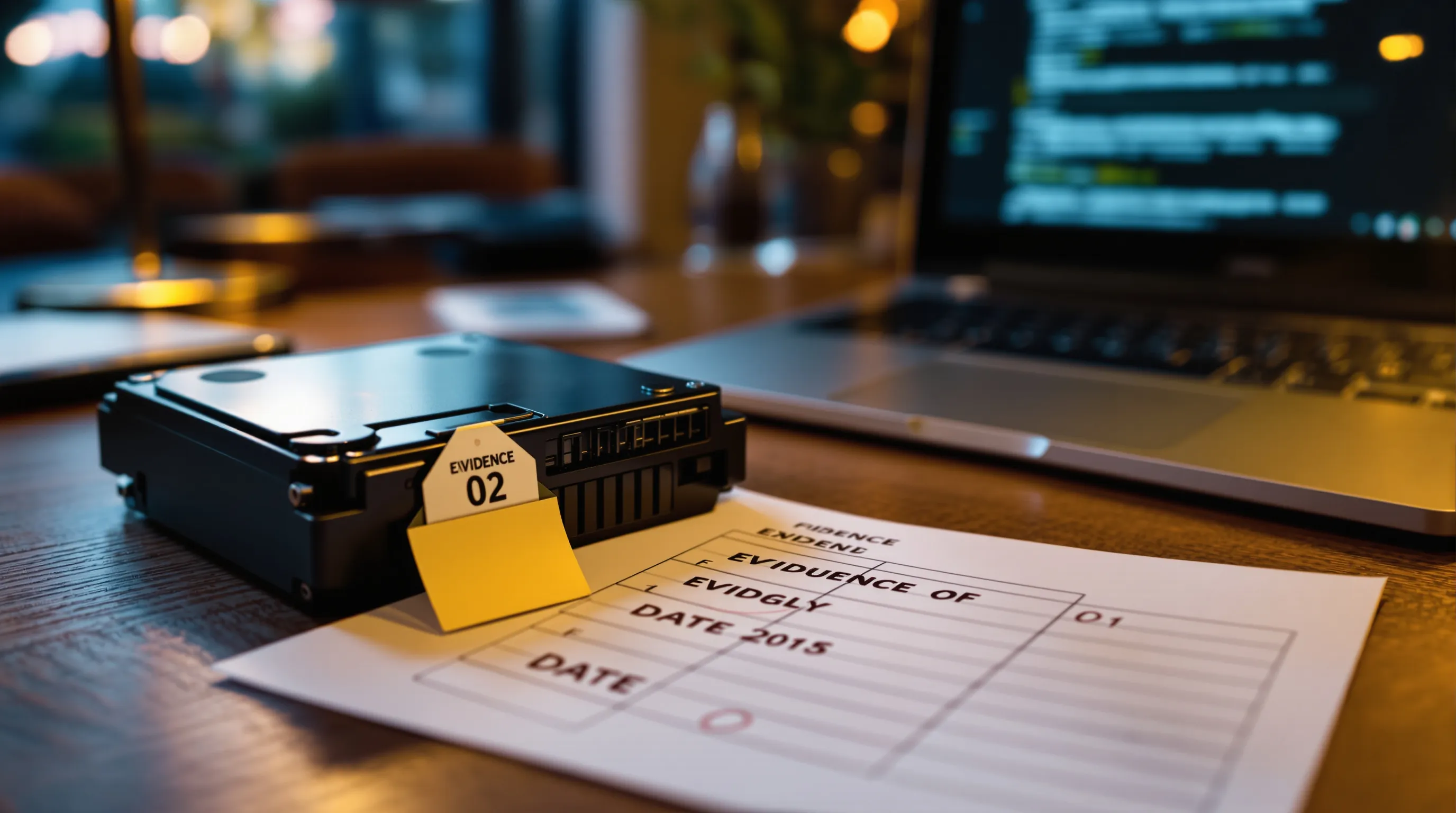
Three metadata fields mislead most often: Date Created on copied files, Author on templated documents, and Last Modified after collection. Treat each as corroboration, never as a timeline's anchor.
The Florida Bar Journal listed "User name and computer name" among the metadata a lawyer must understand, and that is precisely what an inherited Author value can misstate. An odd value is a question about the collection path. It is not, by itself, proof that anyone tampered with anything.
Key Points
- In 2024, an r/ediscovery reviewer found 4,000 non-duplicate PowerPoint presentations sharing one Author, John Doe, and one Created Date of 1/31/1999, pointing to a copy or migration, not drafting.
- A 2022 r/ediscovery thread reported that Microsoft 365 Advanced eDiscovery zip exports changed SharePoint modification times, so Nuix's Item Date showed when files entered the zip.
- Plaintiff Magazine's spoliation guide lists the three Victor Stanley II elements, a duty to preserve, a "culpable state of mind" and relevance, so an odd date alone falls short.
Date Created, Author and Last Modified record something real, though not always what a brief needs them to prove.
A sanctionable loss of evidence requires a duty to preserve, a culpable state of mind and relevance, and an impossible timestamp, standing alone, establishes none of those three things.
Metadata is the information embedded in an electronic file about that file, and practice guides for small firms list the familiar examples as creation date, date last accessed and date last modified. Practitioners have long said that much of the confusion begins with the word itself, used at once for descriptive fields, embedded files and system files. It is worth asking, before reading further, which exhibit in your current matter would lose its footing if its Date Created turned out to mark a copy. So for each date in a draft chronology, write down which field supplied it. For each name, look for something besides the Author property that puts that person at the keyboard. And for each Last Modified value, check whether it falls on or after the day the data was collected.
The obligation to know the difference has moved onto counsel. "It is a responsibility," Adriana Linares wrote of metadata in the Florida Bar Journal in January 2016, in the same piece that reported the Florida Bar's Board of Governors had modified CLE requirements to include "three credits of technology courses during every three-year reporting cycle." A lawyer who cannot explain a field to a jury cannot defend it to a judge.
What follows takes each of the three fields in turn, attending closely to what it actually records, when, and by whose hand, before setting out how a small firm can test a value before leaning on it, and how that testing holds when opposing counsel presses on the very date or name a brief was built around. I have tried to keep the attention on particulars, because in this landscape the particulars are where the truth of a document tends to live.
An email attachment can carry a date later than the email that delivered it, and in a production that impossible order is ordinary rather than rare. A January 2025 r/ediscovery thread described it plainly, an attachment dated after its email was sent, "which makes no logical sense," and the poster had seen it with multiple clients. The trail led to Nuix's primary date field, built from a ranked list of fields with the file system modified date near the top, and to email vaults that split messages apart for storage and rejoin them on retrieval, leaving each attachment with a fresh file system date. Under that poster's exchange protocols, which carry a single date field, the later date is the one opposing parties see.
The fault is quiet. Date Created on copied files, Author on templated documents and Last Modified after collection each record something real, though rarely the thing a brief needs them to prove. Genuine tampering tends to leave a different trace: in OZ Optics v. Zeynep, an executive ran a scrubbing program on a company laptop before handing it over, a forensics expert detected it, and the court ordered a $90,000 sanction. I would carry that distinction into any meet-and-confer. A strange date is a question about the pipeline. A discovered wiping program is evidence about a person. Metadata, read with that kind of attention, corroborates a story, and it should never be asked to carry one alone, which is why the place to begin is with what Date Created and Author actually record.
What Do Date Created and Author Really Record?
Date Created usually marks when the copy in front of you was made, and Author usually names whoever built the original template, so neither proves who drafted a document or when.
In 2024, a reviewer on the r/ediscovery forum described 4,000 non-duplicate PowerPoint presentations in an opposing production, every one carrying the same Author, John Doe, and the same Created Date of 1/31/1999. As the reviewer put it, "a single person cannot create 4,000 different slide decks on the same day," and so the honest question is what those two fields were recording all along.
Before either field enters a timeline, I put it through three plain questions:
- Does the date cluster? Many unrelated files sharing one Created Date point to a copy, migration or scan event rather than to drafting.
- Does the name repeat across unrelated work? One Author on thousands of files suggests an inherited template.
- Do the natives agree? Ask for a few native files and compare their metadata with the load file before concluding anything.
Date Created is the date the version you are viewing came into being, which is to say the copy, NOT the draft. A commenter in that same 2024 thread called it a "low quality" field whose name is deceiving, and joked about renaming it the "Collected Date," because a non-forensic collection rewrites it. Others in the thread traced the pattern to data migrations, the retiring of an old file server and the wholesale moving of its contents to new storage without preserving date stamps, and to scan bureaus and batch processing that stamp a single date across everything they touch.
Author is subtler, because it carries a person's name. In Office files it is a document property, which is why Nuix Discover files it under its Office Property metadata, and why practitioners in a separate 2024 thread found the query syntax for it differs between Nuix Discover and Nuix Workstation. The common assumption is that a name in the Author field works like a signature. It behaves more like an inheritance: one commenter described users working from a template of a template made a decade ago, carrying forward the name of a long departed original template maker, "all the users blissfully unaware." Another moved over 100 gigabytes of data between storage locations and found their own name on every file.
A native file does not settle the matter either. In another exchange, produced .MSG natives carried the same impossible timestamps as the review data, so the error lived inside the files themselves. A comparison of 5 sources behind this section points one way. On a 2023 Microsoft podcast, the company's Director of Discovery Programs described the first step toward reliable filtering as complete extracted text and a complete rendering of the metadata, and for these two fields that means reading what a document says about its own making beside what its properties claim.
Published guidance still presents a creation date as strong enough to undo a party's timeline, and sometimes it is, though that strength depends entirely on how the file travelled. Where files travel is a matter of custody, which is why Relevant e-Discovery runs inside the client's own AWS account under the client's own keys, a trust posture almost no small-firm tool can match, and a question I take up further in whether your e-discovery AI trains on your case data. The name on a file is a clue. It is not a confession.
And if Date Created marks the copy and Author marks the template, the third field, Last Modified, marks something stranger still: the moment the collection itself reached in and touched the file.
Why Does Last Modified Change During Collection and Export?
Last Modified changes because the discovery pipeline itself writes to it: export packaging, email vaults and deduplication can each replace the user's last edit with a processing event.
If Date Created and Author are bent before anyone collects a file, Last Modified is worse, because it can be bent by the very process meant to preserve it. Three mechanisms recur. Mordor Intelligence estimated that SaaS and cloud deployment held 76.45% of the e-discovery market in 2025, so cloud export steps of this kind sit on the ordinary path of a collection, and their settings are worth asking about before collection begins.
Zipped exports from Microsoft 365
In a 2022 r/ediscovery thread, a practitioner reported that exporting from Microsoft 365 Advanced eDiscovery, which packages review set data in zip files, changed the modification time of SharePoint documents. When Nuix processed them, its Item Date field, the one its automated date filter relies on, showed when each file was added to the zip rather than when anyone last edited it on the SharePoint site. Not everyone in the thread agreed on the cause. One commenter said zipping normally leaves file metadata alone and suspected an earlier copying step, while others said Core eDiscovery, which does not zip SharePoint documents, had served them for years without trouble, and one team reported collecting 4x faster with it in a rough comparison.
The disagreement matters less than the result. A date filter run on that field culls by export day, not by conduct.
It is a little like a postmark, which tells you when a letter passed through the sorting office and nothing at all about the evening it was written. No one would date a letter by its postmark. Yet a date range built on a rewritten Item Date does something very close to that.
Email vaults that split and reassemble messages
A subtler version lives in email. Attachments turn up in productions bearing dates after the email that carried them was sent, a sequence that makes no sense until one learns that some archiving vaults strip messages apart for storage and recombine them on retrieval, leaving each attachment with fresh file-system dates the vault never corrects. Processing tools that build a primary date from a ranked list of fields, with file-system modified high on that list, then surface the wrong one. Where the exchange protocol carries only a single date field and no separate sent date, the misleading attachment date is the one opposing counsel sees. Linked cloud attachments set a second trap, because the collection tool follows the link to the latest version of the document rather than the version as sent.
Deduplication that keeps one date and discards the rest
The third mechanism is quieter still. A 2020 r/ediscovery post observed that Nuix and Relativity normally deduplicate on file content alone, not on filename or date. Office documents carry their create and modified dates inside their content, so those survive; text files and PDFs stripped of metadata depend on the file system, so when duplicates are suppressed, the dates and filenames of the discarded copies can vanish. The same poster noted that DOJ production requirements include a Custodian Append File, yet "All Filenames" and "All Dates" fields are generally not requested.
In practice, the surviving date belongs to whichever copy the tool happened to keep.
None of this is visible from the field alone. It becomes visible only when someone sets the date beside the collection path, the parent email and the document's own content, the kind of patient cross-checking that manual review prices out of a small matter. Relevant e-Discovery runs AI-assisted review at cents per document, against the dollars per document and roughly $19K/GB of manual review, which makes that comparison affordable across a whole collection rather than a hopeful sample. The collection path still has to be sound, and forensic imaging is not a job for your IT person, since a careless copy can rewrite the very date you mean to defend.
Which leaves the firm holding a production with a practical question: how to test a date before staking a filing on it.
When a metadata value looks impossible, who actually wrote it?
Four thousand different slide decks, one author, one creation date in January 1999. A reviewer facing that pattern has to decide whether it reveals a cover-up or something far more ordinary.
The pattern surfaced in October 2024 on r/ediscovery, a forum where e-discovery practitioners compare notes. In a production of "several million documents," a reviewer had found 4,000 non-duplicate PowerPoint presentations sharing one Author and a Created Date of 1/31/1999, and wondered about "pre-production metadata manipulation" by opposing counsel.
Most practitioners who answered looked elsewhere. One called the tampering theory "likely the wrong one to make." Another said companies often copy files without preserving dates or ownership, and that an old date points to "a migration such as retiring an old file server and moving everything to a NAS/New Server." A third had seen the effect firsthand: after moving "over 100 gigabytes of data," every file showed "my name as the author," dated the day of the transfer.
Asking for natives is the usual first check, and a February 2024 thread shows where it runs out. About a dozen emails claimed to have been "sent out within a second of each other," and the produced .MSG natives carried the same impossible times. One commenter read the pattern instead: the identical times came in blocks, each "a few days later" than the true date, "which also means it can't be a time zone issue," and other traces showed the emails opened on the expected days. The verdict: "some mass-action was performed on them, regularly, that caused only one of the values to get botched." Another commenter ranked collection problems, third-party email repair and format conversion ahead of the processing tool. Nobody could name the event for certain.
| What you see | What practitioners suspected | What to ask for or check |
|---|---|---|
| Thousands of unrelated files share one old Created Date and one Author | Migration from an old file server, or a non-forensic copy | A few natives, the original metadata, and when any migration happened |
| Every file names the same person as author, dated the day of a transfer | Whoever moved the files | Who moved them, and when |
| Blocks of emails "sent" within one second, natives included | A recurring mass action, a collection problem, email repair or format conversion | Chain of custody, hash values, file paths, processing time zone |
| An attachment dated after the email that carried it | A file-system date winning the primary date, vault reassembly, or a linked attachment | Embedded application date, parent email date, the version as sent |
The last row turns on where a value is stored. Office files keep their dates inside the file, a practitioner noted in 2020, while text files and metadata-stripped PDFs "just rely on the file system," and those dates can be lost when duplicates are suppressed. A file-system date filling the primary date field is one way an attachment comes to postdate its email, as described above. A January 2025 commenter preferred the date the application embeds, which "tends to remain intact, unless it's been scrubbed." Another suggested linked attachments in internal mail, where collection follows the link to the newest version, "not the version as-sent." Then the content may have changed along with the date.
None of this makes an odd value harmless. Practitioners disagree about who owns the problem once it appears.
"Opposing counsel is now facing a spoliation claim and it's their problem to answer all of your questions about what happened to this botched metadata, to your satisfaction."
A practitioner replying on r/ediscovery, 2024
In Bray & Gillespie v. Lexington Insurance, as a 2009 legal podcast recounted it, the insurer asked for native email with metadata intact and received TIFF images with none. Plaintiffs' counsel said the email had been printed and scanned, then disclosed before the hearing that it had instead been converted with a program designed to exclude certain metadata. The magistrate judge found a Rule 34 violation, held the stripped images were not a "reasonably usable form," and ordered the lead attorney to pay the insurer's fees and costs.
Every strange value we traced recorded something real: a migration, a transfer, a recurring mass action, a followed link. The value was accurate about an event, and the event was rarely the conduct in dispute. Where a court did punish someone, the punishment followed a false account of the handling. So for any strange date or author, ask what happened to the file, and whether the party that handled it can explain that accurately.
- Before alleging tampering, describe the pattern: how many files share the value, whether the date is years old or near collection, and whether one field is off or several.
- When one name is Author across thousands of unrelated files, ask who ran any migration or transfer, and when.
- Ask for a few natives and the original metadata. If the natives match, ask for chain of custody records, hash values, file paths and the processing time zone.
- Ask which field filled the primary date for attachments and stripped files, and compare it with the embedded application date and the parent email's sent date. For internal mail with linked attachments, ask whether you received the version as sent.
- Get the producing party's account of collection and conversion in writing before you build on any date or author value.
How we checked this
We read four practitioner threads on r/ediscovery from 2020 to 2025, a 2009 legal podcast episode recounting the Bray & Gillespie sanctions decision, and the text of Federal Rule of Civil Procedure 34. None of the figures here come from us. The forum posts come from anonymous practitioners describing single matters. They often offer competing explanations, they cannot be independently verified, and none of them measures how often each cause occurs. Our account of Bray & Gillespie is secondhand, taken from a podcast produced by an e-discovery services company, and not from the opinion itself. We sell AI eDiscovery review software built around hashed originals and documented chain of custody, so we have a stake in how this question is answered. Still unknown: how often an odd metadata value turns out to be deliberate alteration. None of our sources counted.
- r/ediscovery, thread on thousands of documents sharing one author and date, October 2024.
- r/ediscovery, thread on email timestamps within one second, February 2024.
- r/ediscovery, thread on attachment dates after the sent date, January 2025.
- r/ediscovery, thread on metadata lost in deduplication, January 2020.
- The ESI Report podcast, episode on production format and attorney sanctions, April 2009.
- Legal Information Institute, Federal Rule of Civil Procedure 34 text, retrieved October 17, 2026.
How Can a Small Firm Verify Metadata Before Relying on It?
Preserve hashed, unaltered originals with a documented chain of custody, then corroborate every date and author against the document's content, its parent email and the collection path before it reaches a filing.
Once all three fields are suspect, the question for a small firm is no longer whether to trust metadata but how to prove which dates and authors are real without a forensic budget. I would not begin with software. I would begin with sequence, because most of the damage described above happens in the first hours of handling, when someone opens a native file or drags a folder onto a new drive, and no later diligence can recover what that moment overwrote.
The American Bar Association's GPSolo magazine made the point plainly in 2024: opening a native document risks "inadvertently altering its metadata," while a review platform's near-native view shows the document as it appears in its original format without opening it at all. The same article recommends the scheduling conference "mandated by Federal Rule of Civil Procedure 26(f)" as the natural moment to settle the nature, volume and mechanics of ESI production.
From those two points, a workable order of operations follows:
- Freeze the originals first. Collect forensically, hash each file, and review in near-native form so that no one's curiosity becomes an edit.
- Settle the fields at the Rule 26(f) conference. Agree on form of production and on which metadata fields will be exchanged, including which source fills each date field, while both sides are still cooperating.
- Corroborate before you cite. Pair each date or author with at least one independent witness: the text of the document, the parent email, the custodian's account or the collection log.
- Ask before you accuse. When a production carries impossible values, request a few natives and an account of the collection path before drafting any motion.
The third step is where most timelines are won or lost, and a paired example shows the difference.
Before: "The pricing memo was written by the sales director on the date shown in Date Created."
After: "The pricing memo carries the sales director's name in the Author field and a Date Created consistent with the export; its text describes the meeting recorded in the parent email, which the custodian confirmed."
The second version claims less and survives more. It survives because no single field is asked to carry the whole weight.
Contrary to the instinct that an impossible date means someone lied, the law asks for considerably more. Plaintiff Magazine's guide to spoliation motions sets out the three elements from Victor Stanley II: a duty to preserve when the evidence was destroyed or altered, a "culpable state of mind," and relevance. The proof in that case was not an odd timestamp but an executive deleting files just before his computer was imaged, followed by a defragmenting program that made them unrecoverable. Microsoft's Director of Discovery Programs recommended a habit a small firm can borrow, searching known data for things you expect to find before trusting results you cannot predict, and for dates that means first checking a handful of documents whose real history you already know. It is not yet an accusation.
This is where I think tooling earns its place, not by deciding which date is true but by keeping every conclusion tethered to the document that supports it. In Relevant e-Discovery, every answer links back to the exact exhibit it came from, so an attorney can verify it with one click before filing, which is the structural answer to the sanctions risk that Mata v. Avianca made familiar. The ABA article asked how a lawyer can explain the significance of metadata to a jury without understanding it first, a question that sits close to the heart of how e-discovery can make you a better lawyer.
What remains is to set the three fields side by side, and to say plainly which of them can bear weight and which can only point the way.
How Does Metadata Hold Up When Opposing Counsel Challenges It?
Metadata holds up when it is offered as corroboration, traced through a documented collection path and matched against content, custodians and parent emails, rather than presented alone as proof.
When opposing counsel presses on a date, the answer that holds is one tied to custody, which is why Relevant e-Discovery keeps Bates numbering, privilege calls and chain of custody in the same tool as its cited answers and chronologies, rather than splitting them across two. As Kelly Twigger said in 2025, "You need to be able to recreate that timeline," so write a one-page account of each disputed file: who collected it, with what tool, and when it was hashed. That is a modest standard. It is also an unforgiving one.
Many states have adopted the ABA Model Rules on digital and electronic evidence, and an ABA practice guide for solos and small firms concluded that "the days of lawyers choosing how to navigate these challenges have ended." The comment to Model Rule 1.1 already asks lawyers to keep abreast of "the benefits and risks associated with relevant technology," and a Date Created value read as a birth date, when it records only the day a copy landed, sits squarely among those risks. Competence now includes knowing what a field cannot prove.
The questions that follow take up the narrower cases a small firm meets most often, beginning where most challenges begin, with a date that seems to say too much.
Summarize This Article With AI
Open this article in your preferred AI engine for an instant summary.
Frequently Asked Questions
What Else Do Litigators Ask About Misleading Metadata?
Most follow-up questions concern what to request, when to settle fields, and whether a bad date can support sanctions; each answer below turns on naming fields precisely and documenting where values came from.
Should I ask for "all metadata" in a request for production?
No. A 2011 practitioner discussion described "all metadata" requests that could pull 145 fields out of Outlook when the requester probably wanted about 12. The third edition of The Sedona Principles (2017) tells requesting parties to specify technical details, "such as the need for particular fields or metadata." I would name Date Created, Author and Last Modified outright, and ask which source populates each.
When do metadata fields have to be settled in federal court?
Early. Under Sedona Principle 4, form of production and metadata fields must be discussed at the Rule 26(f) conference and written into a discovery plan, ESI protocol or stipulation. A field left undefined there tends to resurface later as a dispute.
Can an impossible timestamp support a sanctions motion?
Rarely on its own. Sedona Principle 14 treats sanctions as appropriate only when a party acted with intent to deprive, meaning it meant to keep relevant ESI from its opponent, while remedial measures cure prejudice. The 2015 amendments to Rule 37(e) were written to settle a circuit split over that standard. An odd date earns a question, not an accusation.
Do chat apps and cloud files carry the same fields as Office documents?
They do not. Social media posts, audit logs, email, Slack, WhatsApp and Signal each carry different metadata fields, so a protocol drafted for Word files will not map cleanly onto them. Hyperlinked files add relational metadata, the link tying a shared file to the message that carried it, much as an attachment is tied to its parent email. One case law database counted more than 40 decisions on hyperlinked files from 2021 forward.
Are courts getting stricter about metadata mistakes?
By one experienced practitioner's 2025 account, yes. Courts have grown increasingly less tolerant of counsel who do not understand or follow their duties to preserve and produce ESI, amid more than 5,000 discovery decisions a year for several years running. The same account found sanctions under Rule 37(e)(2) leaning toward adverse inference rather than terminating sanctions.
Does a litigation hold need to be in writing?
Yes. A verbal request or a single email is not enough; practitioners have long urged a written hold with a log of who received it and who complied. Sedona commentary adds that defensibility improves when the legal team meets hold recipients to confirm they understand, which is also the moment to ask each custodian where their files have traveled.
Written by
Michael
Kansky
Michael Kansky is a serial software entrepreneur who has spent more than two decades building and bootstrapping profitable SaaS and services companies.
Connect on LinkedInRead next
 E discovery
Can You Move EU Employee Data to a U.S. Review Platform?
Usually not as a first move. Some foreign laws prohibit sending discovery documents to the United States, so review EU employee data in-region and send only a reduced, documented set.October 11, 202622 min read E discovery
Why AI Semantic Search Still Misses the Documents That Matter
Yes. AI semantic search misses documents whose relevance depends on exact identifiers, account numbers, internal code names, and proprietary abbreviations. These are terms the model cannot semantically anchor because no training context established their meaning.September 23, 202619 min read E discovery