
Quick Answer
Private AI deployment keeps your client's privileged documents inside a dedicated single-tenant environment where no shared inference infrastructure can touch them. According to Reveal's 2026 eDiscovery Buyers Report, 91% of major buyers now report growing demand for private or on-premises AI deployments. For matters involving attorney-client privilege, regulated data, or protective-order productions, private deployment is not an optional upgrade. It is the professional baseline the market has settled on, and the reasons for that consensus are architectural, not merely contractual.
Cloud-by-default was a procurement shortcut, and Reveal's 2026 eDiscovery Buyers Report has now documented the size of the correction: 91% of major buyers report growing demand for private or on-premises AI deployments, drawn from a survey of 200 senior legal technology decision-makers. That number is not an indictment of cloud technology generally. It is an indictment of the process by which cloud became the default for a specific, peculiar category of data: attorney-client communications, work product memoranda, documents produced under protective orders, materials generated by clients in regulated industries. For that category, the deployment decision was made without a privilege analysis, and the market has spent several years working out what that omission actually means in practice.
The documents that move through a discovery review platform are, by definition, the materials a case depends on. They include communications between attorneys and clients that courts protect precisely because they should not travel freely. The question of where those documents reside during AI-assisted review, whose infrastructure processes the inference, and what logs that processing generates is not a minor technical preference. It is a professional responsibility question with case-outcome consequences. The 91% figure establishes that the majority of sophisticated buyers now treat it as such.
Relevant Discovery's platform processes your documents single-tenant, inside your own AWS account under your own keys, with no vendor retention and no model training on your matter data. Nothing you feed into the platform trains anyone's model or waives privilege. That architecture is not a premium feature; it is the baseline the market is now demanding, and the technical reasons for that demand are examined below.
Forecast window: 12-24 months
Where private deployment heads in e-discovery
Three scored forecasts on how private and in-account processing reshapes e-discovery buying over the next two years.
How buyers will procure sensitive review
Read each forecast as a checkpoint for your next platform decision, weighing the confidence and the market signal behind it.
Over the next 12-24 months, private or on-premises deployment moves from a niche request to a default requirement in e-discovery procurement; the 2026 Reveal Buyers Report already shows 91% of 200 senior legal-technology decision-makers reporting that their share of matters demanding it grew over the prior 24 months, and single-tenant processing under the client's own keys, with no vendor retention or model training, becomes the standard buyers require.
By 2027, AI-assisted document review settles in as a recurring operational line item rather than experimental pilot spending; Gartner's projection that 40% of enterprise applications will carry task-specific AI agents by 2026, up from under 5%, together with the early-2026 launches of autonomous review from Thomson Reuters CoCounsel and LexisNexis Protégé, points to agentic review becoming standard, with per-document cost falling toward cents against roughly $19K per gigabyte for manual review.
The conventional expectation is that the largest incumbent's cloud consolidation captures the market; instead, its firm sunset date for the long-standing on-premises platform will push a meaningful share of buyers toward private, in-account alternatives rather than follow that vendor's re-platforming timeline, opening the solo and small-firm segment that Relativity and Everlaw price out to enterprise-grade defensibility at small-matter economics over the next 12-24 months.
Faint signals worth tracking: Buyers are writing data residency, model access, and no-model-training terms directly into review platform requirements, treating them as pass/fail conditions rather than nice-to-haves. AI money has already moved from experimental pilot lines into standing operational e-discovery budgets, and incumbents are now shipping autonomous, multi-agent review rather than demos. Buyers facing a forced re-platforming deadline are actively comparing the incumbent against other platforms and asking how to cut the cost of document review in litigation.
What the 2026 buyer survey and market data show
Each forecast lists both the sources that support it and the sources that would cut against it.
- Reveal: What Decision-Makers Look for When Buying an eDiscovery Platform is the strongest public backing for this call. [Industry Publication]91% of eDiscovery buyers report that their share of matters requiring private or on-premises deployment has grown over the past 24 months (Reveal, 2026 eDiscovery Buyers Report). “where does the data live, and whose AI model is touching it?”
- Architecting the Autonomous Legal Enterprise: From Machine Learning to Multi-Agent Systems supports this forecast. [Blog]A recent survey found 28% of legal professionals named contract review as their most impactful AI use case. “The leverage now sits in deciding how AI gets deployed across the legal department - which workflows get automated, which models get trusted with privileged…”
- Reveal: What Decision-Makers Look for When Buying an eDiscovery Platform points the same way. [Industry Publication]The 2026 eDiscovery Buyers Report is based on a survey of 200 senior legal technology decision-makers (Reveal).
- Reveal: What Decision-Makers Look for When Buying an eDiscovery Platform is what puts this forecast on the board. [Industry Publication]The market's largest incumbent has set a firm sunset date for its long-standing on-premises platform, forcing buyers to re-platform on that vendor's timeline (unnamed, but industry context points to Relativity/RelativityOne migration).
What could reverse the private shift
These are the real-world conditions that would pull buyers back toward cloud-by-default deployment.
Read this with care
A score measures how much current evidence backs a call, and that evidence keeps moving. The top forecast here sits at 95/100, while the minority view at 95/100 shows where the sources still disagree.
- Private, client-key deployment becomes the procurement baseline. Buyers changing priorities, or regulators changing rules, hit that call first.
- Forced cloud migration splinters the market downward. A source base that turns contrary would leave that as the forecast still standing.
Questions This Article Answers
- Why are 91% of major e-discovery buyers now demanding private AI deployments instead of cloud?
- How does multi-tenant cloud infrastructure create attorney-client privilege exposure risk during document review?
- What does a single-tenant deployment actually change for firms handling privileged or regulated matters?
What Does "91 Percent Want Private AI" Actually Tell Us?
The Reveal figure deserves some precise reading before the conclusion is drawn from it. What the 2026 eDiscovery Buyers Report actually measures is whether a buyer's share of matters requiring private or on-premises deployment has grown over the past 24 months. Not whether 91% of all matters are handled privately. The survey asked 200 senior legal technology decision-makers whether demand had increased, and 91% said yes. The implication is directional, not absolute: the market is moving decisively toward private, and nine in ten decision-makers are moving with it.
The movement itself is what is significant. These are professionals whose job is to evaluate and procure e-discovery platforms. When nine in ten of them report that more of their matters are requiring private deployment, the platform selection calculus has shifted, and the shift is consistent enough to constitute a market consensus rather than an isolated trend, as of .
What the buyers are describing when they say "private" is a deployment model in which the AI infrastructure running their document review sits inside an environment they control or that is dedicated exclusively to their organization. Their documents do not pass through inference pipelines shared with other law firms' matters. Their relevance scores are generated in compute isolated from the surrounding vendor infrastructure. As Reveal's own research frames it, every eDiscovery RFP now merges two formerly separate questions: "where does the data live, and whose AI model is touching it?"
The shift has two drivers. First, AI in e-discovery has moved from pilot budget to operational line item. When firms were running AI on non-sensitive matters as proofs of concept, the infrastructure question was abstract. When AI is the primary review mechanism on active privileged matters, the infrastructure question becomes professional responsibility. The same deployment decision that was reasonable for experimentation is not automatically reasonable for production review of attorney-client communications.
Second, vendor due diligence has become more specific. The contract terms governing multi-tenant cloud platforms have received more scrutiny as AI moved from novelty to infrastructure. Standard cloud agreements typically reserve broad rights over usage data, and the definition of what qualifies as anonymized or aggregated data does not always map cleanly onto what privilege requires. Buyers have begun asking vendors to specify, precisely, which systems process their documents and what happens after processing. The answers for private deployments are categorically different from the answers for standard cloud offerings.
The finding also inverts the burden of proof in vendor conversations. For most of the AI era in e-discovery, private deployment required justification: framed as expensive, harder to manage, appropriate only for unusual circumstances. When 91% of major buyers report growing demand for private deployment, cloud-by-default is what now requires justification. The structural circumstances that made cloud the initial default have not changed; the analysis of whether those circumstances were ever appropriate for privileged review has. In summary, the 91% figure is evidence of a correction to an assumption that was set before the profession had fully evaluated its consequences.
What Will Matter Most in the Next 12 to 24 Months
Three developments will determine how quickly private deployment moves from the majority preference documented in the 2026 Buyers Report to the universal professional standard.
Courts Will Begin Ruling on AI Infrastructure and Privilege
The privilege implications of multi-tenant AI review have not been definitively litigated. That will change. As AI review becomes the standard mechanism for large document sets, opposing counsel will increasingly probe the deployment specifics in discovery disputes and sanctions motions. The questions are already being asked in meet-and-confer conferences: which systems processed your documents, who at the vendor had access to inference logs, what does your vendor's training data policy cover.
The first ruling that finds a waiver argument plausible based on multi-tenant inference exposure will shift the entire market's analysis overnight. Firms using private deployment will be insulated from that ruling. Firms on multi-tenant cloud platforms will be revising their vendor agreements under time pressure and retroactively evaluating every privileged matter they reviewed on shared infrastructure. The professional advice for avoiding that situation is straightforward: address the architecture question before the motion is filed, not after.
Regulatory Requirements Will Codify What the Market Is Already Doing
Data residency and processing location requirements are tightening across the sectors that generate the most e-discovery: healthcare, financial services, and government contracting. Several U.S. jurisdictions are examining AI-specific requirements for legal technology. The 91% figure is ahead of regulation, but regulation will eventually reach the same conclusion the buyers already have. Firms that have already moved to private deployment will experience new data residency requirements as compliance confirmation rather than compliance work. Firms still on default cloud will face a transition under regulatory pressure rather than at their own pace.
Clients Will Begin Specifying Deployment Requirements Directly
The buyers in Reveal's survey are sophisticated organizations: large enterprises, regulated companies, and frequent litigants. They are already asking their outside counsel about AI deployment specifics. The next step is for those questions to appear in outside counsel guidelines, engagement letters, and matter-specific data handling agreements as standard provisions rather than special requests.
In my experience, the clients who care most about this are precisely the clients whose matters are most valuable and most sensitive. Being able to confirm private deployment from the first engagement conversation is a capability that will matter for client retention in regulated sectors over the next 24 months. In summary, the window between now and when private deployment becomes the universal professional standard is the window in which addressing the infrastructure question is a strategic advantage rather than a minimum requirement.
How Does Multi-Tenant Cloud Create Attorney-Client Privilege Risk?
Multi-tenant architecture means that different customers' workloads run on shared infrastructure. In most SaaS contexts, this is the efficiency proposition: shared servers, shared databases with logical separation, shared AI model inference pipelines.
The cost is lower because the infrastructure is shared. For most document types, this is not a material concern. For attorney-client communications describing case strategy, the analysis is different.
The specific mechanism that creates privilege risk in e-discovery is the inference pipeline. When you upload a document to a cloud-based review platform and the AI scores its relevance, that scoring operation runs on compute that may simultaneously be serving other clients. The inference pipeline generates logs: which documents were scored, what features the model examined, what the output scores were. Those logs exist in the vendor's infrastructure, accessible to vendor personnel under normal operational circumstances, including support engineering work, performance diagnostics, and routine audits.
For most document types, this is not a material concern. For attorney-client communications describing case strategy, the analysis is different. The question is not whether the vendor has malicious intent. The question is whether the technical architecture creates a pathway through which privileged information could exit the attorney-client relationship, and whether that pathway was known and consented to at the time the platform was selected.
There is a second risk that receives less discussion: training data inclusion. Most large AI vendors include language in their terms of service reserving the right to use customer data to improve the model, subject to anonymization requirements. What "anonymization" means when applied to legal strategy contained in an attorney-client communication is not a question those terms were written to answer. The terms were drafted for general SaaS contexts and imported into e-discovery platforms without the kind of revision that a data-handling analysis of privileged communications would require.
Professional responsibility rules in most jurisdictions require attorneys to take reasonable measures to prevent unauthorized disclosure of client information. The question of whether using a multi-tenant platform for privileged review satisfies "reasonable measures" is one that reasonable attorneys can answer differently, particularly as courts begin to examine the infrastructure specifics of AI-assisted review in sanctions and waiver motions. The absence of a definitive ruling is not protection; it is the period before a ruling.
The specific concern I encounter most often from litigation partners is not about malicious access. It is about inadvertent disclosure through the ordinary operation of the platform. A vendor support engineer accessing inference logs to diagnose a performance issue. A model training run that includes a document the anonymization process failed to scrub. A security incident that exposes shared infrastructure logs. None of these require bad faith. All of them require the privileged document to have been in shared infrastructure to begin with. In summary, the privilege risk from multi-tenant cloud is structural, not hypothetical, and it is the risk the 91% of buyers are working to eliminate.
What a Single-Tenant Deployment Actually Changes for Privilege Protection
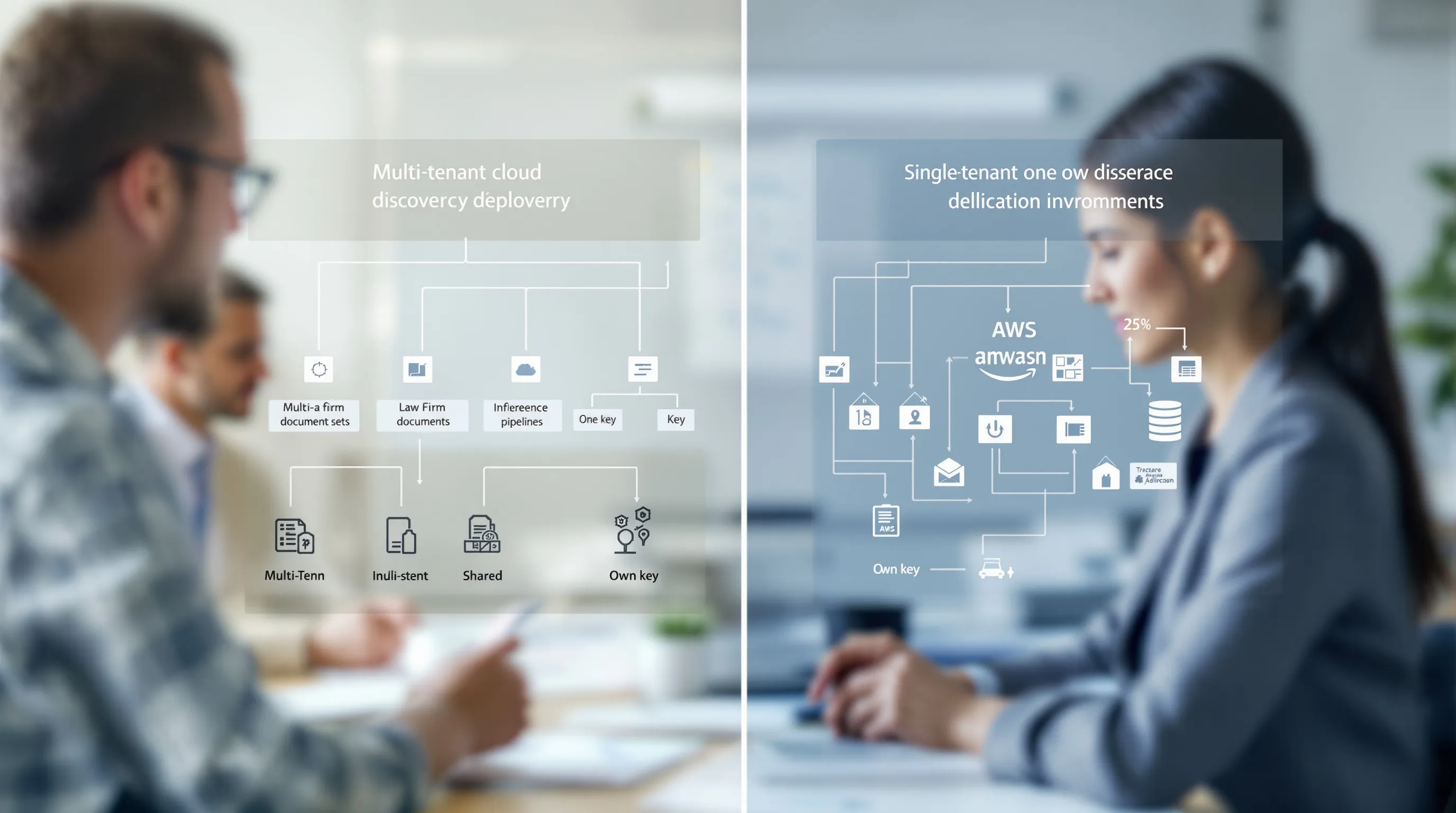
A single-tenant deployment means that the entire AI inference stack processing your documents runs in infrastructure dedicated exclusively to your organization.
There is no shared compute with other clients' matters. There are no cross-tenant inference logs. Relevant Discovery's platform runs inside your own AWS account, under your own encryption keys, with no vendor retention of your matter data and no model training on what you upload. Processing runs single-tenant, or inside your own AWS account, with no vendor retention and no model training. Nothing you feed it trains anyone's model or waives privilege.
The practical difference from a privilege perspective is that the unauthorized disclosure analysis changes substantially. In a multi-tenant environment, the question is whether shared infrastructure creates a waivable disclosure risk and whether the contract terms adequately limit that risk. In a single-tenant environment, the question is simpler: your documents stay within an environment whose access controls you govern, and the only people who can see your inference outputs are the people you authorize.
The second difference is training data exclusion. A private deployment does not feed your documents into any shared model training pipeline. The models run within your tenancy boundary and do not receive training updates based on your production data. This is an architectural guarantee, not a contractual promise, and the distinction matters: architectural limits cannot be accidentally violated by a configuration error in a model training job the way contractual limits can be violated by a vendor's operational decision.
| Factor | Multi-Tenant Cloud | Single-Tenant (Relevant Discovery) |
|---|---|---|
| Inference pipeline isolation | Shared compute with other clients; logical separation only | Dedicated compute inside your AWS account; no cross-tenant access |
| Inference log access | Accessible to vendor operations staff under standard procedures | Bounded by your tenancy; vendor access requires your explicit authorization |
| Training data inclusion | Subject to anonymization policy and contract terms; model updates may include processed data | Excluded by architecture; no shared training pipeline touches your matter data |
| Privilege waiver analysis | Requires contract review and architectural due diligence before each matter | Substantially simpler; your data does not enter infrastructure you do not control |
| Encryption key control | Vendor-managed; keys accessible to vendor for operational purposes | Your own AWS keys; vendor cannot decrypt without your authorization |
The table above represents the categories where single-tenant deployment changes the analysis. It does not eliminate all risk, and it requires thoughtful vendor selection: a private deployment with a vendor that retains broad contractual access rights is not the same as a deployment inside your own account under your own keys. The architecture is the load-bearing element.
In summary, the implication for matter strategy is direct: for matters where privilege is a live issue, where the client is in a regulated industry, or where the opposing party would have standing to raise a waiver argument, the deployment model of your review platform is a case management decision with professional responsibility dimensions, not an IT preference to be resolved at contract renewal.
The 91% figure is, in the end, documentation of a correction the profession needed to make. Cloud-by-default was never evaluated against the specific requirements of privileged review. It was adopted because cloud platforms were available, capable, and economical, and the privilege analysis was deferred. Reveal's 2026 Buyers Report, drawn from 200 senior legal technology decision-makers, establishes that the deferral period is over.
For firms reviewing their platform decisions now, the analysis is straightforward. Private deployment eliminates the category of risk that arises from privileged documents existing in shared infrastructure. It does not eliminate all risk, and it requires selecting a vendor whose architecture actually delivers the isolation the marketing claims. But for matters involving attorney-client communications, regulated data, or documents subject to protective orders, the deployment question is the first professional responsibility question, not an afterthought at contract renewal.
Relevant Discovery runs inside your own AWS account, under your own keys, with no model training on your matter data. The discussion about whether your next sensitive matter belongs on that infrastructure is one we are available to have at any time.
Written by
Michael
Kansky
Michael Kansky is a serial software entrepreneur who has spent more than two decades building and bootstrapping profitable SaaS and services companies.
Connect on LinkedInSummarize This Article With AI
Open this article in your preferred AI engine for an instant summary.
Frequently Asked Questions
What is the difference between private AI deployment and cloud-based e-discovery?
Private AI deployment runs the inference pipeline inside an environment dedicated to your organization, typically inside your own AWS account under your own encryption keys. Cloud-based platforms run inference on shared multi-tenant infrastructure. For e-discovery, the distinction determines whether your privileged documents pass through infrastructure that also processes other firms' matters, generates logs accessible to vendor staff, and potentially enters shared model training pipelines.
Does using a cloud-based review platform create attorney-client privilege risk?
It creates an exposure pathway that requires analysis. Multi-tenant inference logs are accessible to vendor staff under standard operational procedures. Training data policies may include provisions that apply to processed documents. Whether those factors constitute a privilege risk depends on the platform's specific terms, the professional responsibility rules in your jurisdiction, and the sensitivity of the matters involved. For regulated industries and actively litigated privilege-heavy matters, the analysis generally favors private deployment.
Why do 91% of major e-discovery buyers now want private deployment?
Reveal's 2026 eDiscovery Buyers Report, based on 200 senior legal technology decision-makers, found 91% report growing demand for private or on-premises AI deployment over the past 24 months. The shift reflects AI moving from experimental pilots to operational infrastructure on privileged matters, combined with more rigorous vendor due diligence that surfaces the difference between multi-tenant and single-tenant architectures.
Is private AI deployment significantly more expensive than cloud?
Relevant Discovery's single-tenant AWS deployment is priced as a matter-level or volume arrangement, not as a premium add-on. The infrastructure cost of single-tenant deployment has decreased as cloud providers have expanded dedicated tenancy offerings. The per-document economics are comparable to multi-tenant cloud while eliminating the privilege exposure risk that shared infrastructure creates.
What questions should firms ask vendors about their AI deployment model?
Ask specifically: which systems process your documents during inference, which vendor staff can access inference logs and under what circumstances, what the training data policy covers and what "anonymization" means in practice, whether a single-tenant option is available, and whether the deployment can run inside your own cloud account under your own encryption keys. The precision of the answers tells you more than the marketing summary.
Read next
 E discovery
Does Your E-Discovery AI Train on Your Case Data?
Probably not, in the strict technical sense: your documents were almost certainly not used in the initial pre-training of the foundation model your vendor uses.September 16, 202635 min read E discovery
Where AI Relevance Scores Come From, and What They Hide
AI relevance scores aren't accuracy ratings—they're similarity rankings. Learn what your scores hide before you defend your review.September 9, 202631 min read E discovery