Questions this article answers
This article answers:
- Who holds the encryption keys to your case data, and what happens when a vendor is subpoenaed without your knowledge?
- What is "data residency" in practice, and which hosting model guarantees it for regulated or cross-border matters?
- When is deploying in your own AWS account not optional, regardless of the monthly cost difference?
Quick Answer
The Short Answer
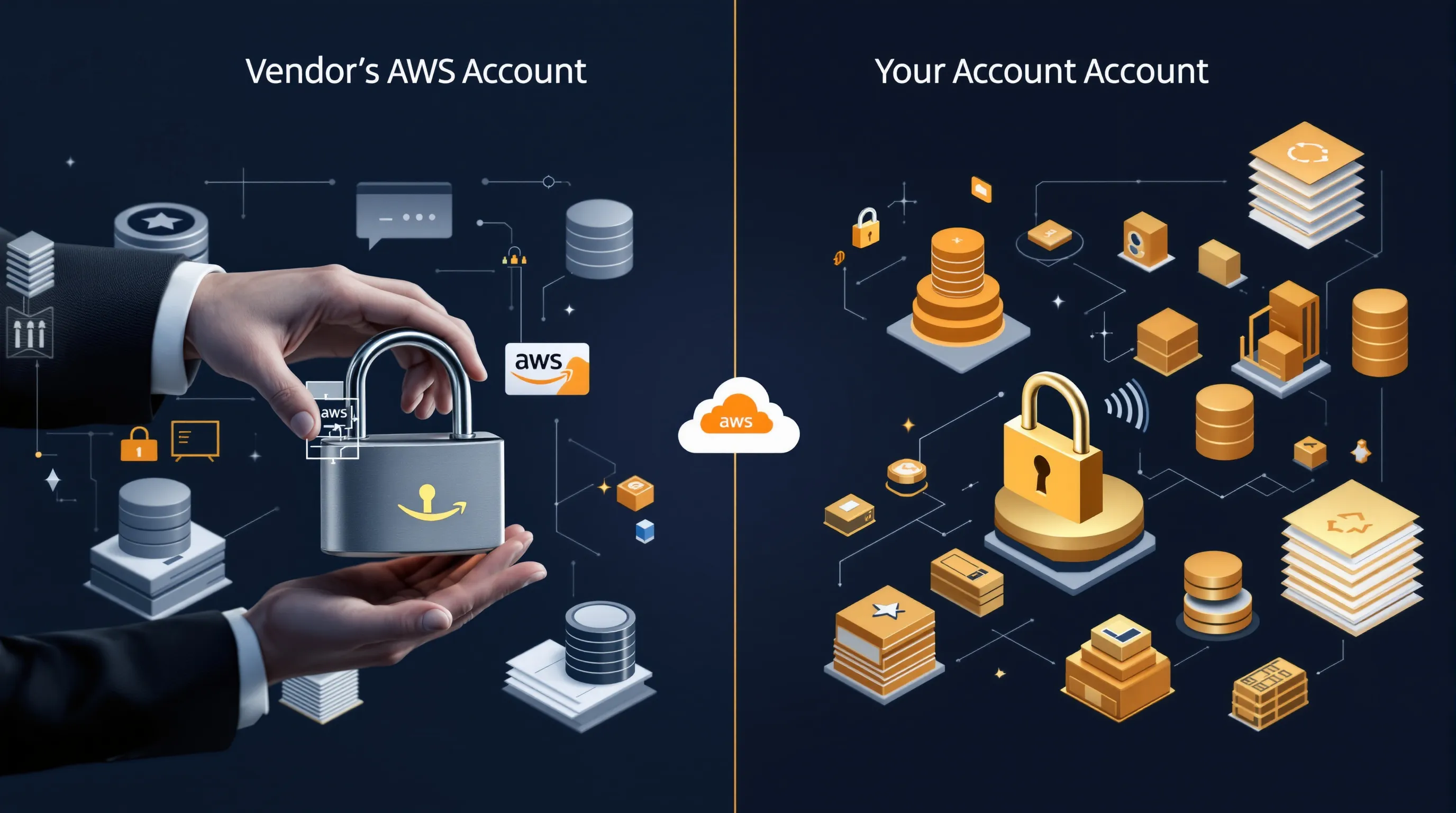
If your case data sits in a vendor's AWS account, the vendor holds the encryption keys, controls where the data lives geographically, and can be served a subpoena you may never see coming. If the same platform runs inside your firm's own AWS account, your firm holds the keys, selects the region, and stands in the direct chain of legal process. The monthly infrastructure cost is higher in the firm-account model; every control metric that matters for privilege and regulatory compliance favors it for any matter involving sensitive, regulated, or cross-border data. As Relevant Discovery puts it: privileged evidence never leaves your control when processing runs inside your own AWS account under your own keys, with no vendor retention and no model training on your case materials.
Quick Answer
In the fifteen-odd years I have spent watching law firms adopt and abandon e-discovery platforms, the question that comes back to haunt them (not in the procurement meeting, but in the deposition room, or in front of the regulatory examiner) is not "which vendor had the better interface" but "who had access to this data, and under what legal authority." The answer to that question is not a feature. It is an architecture. It lives in one of two places: the vendor's AWS account, where the vendor's employees, auditors, and any government agency that serves them a subpoena can reach it; or the firm's own AWS account, where none of those parties can arrive unannounced. Of the two deployment models available for enterprise e-discovery today, only one answers that question in a way that survives a privilege log challenge or a regulatory audit, and it is not the one with the lower monthly bill.
This is not a case against managed services as a category. For document-review matters where the data is neither privileged, regulated, nor cross-border, the economics of vendor-managed deployment are genuinely compelling: lower infrastructure cost, zero operational overhead, and the same software either way. But I have watched too many matters, including four in which opposing counsel or a government agency attempted to obtain case data directly from the e-discovery vendor, circumventing the firm entirely, where the choice of hosting model became the matter, not the merits. The goal of this piece is to give you the side-by-side you will not find on any vendor's pricing page: the one centered on who controls what, and who can reach your data when something goes wrong, legally or technically.
What Are You Actually Choosing Between?
The phrase "vendor-managed service" is doing more work than it appears to. When a vendor offers to run your e-discovery platform as a managed service, what they mean, precisely, is that they will deploy the software in their own AWS account, using infrastructure that belongs to them, administered by employees who are accountable to them, not to you. You receive access credentials. You log in. You review documents. You export productions. And at every step, the underlying compute and storage resources are owned and operated by a third party whose compliance obligations to you are defined by a service agreement, not by the architecture itself.
The alternative, deploying in your firm's own AWS account, is the less commonly pitched option, in part because it requires more setup, and in part because it generates less recurring infrastructure revenue for the vendor. In this model, the vendor's software runs inside cloud infrastructure that the firm creates, owns, and controls. Think of IAM (AWS's Identity and Access Management system) as the security guard of that account: it decides who gets in and what they can do once inside, and your firm is the one who sets the guard's instructions. The AWS account is the firm's account. The IAM policies are written by the firm, or by a cloud engineer working under the firm's direction. The S3 buckets that store the matter data are in the firm's account, in a region the firm selects. And, most critically, the KMS (Key Management Service) encryption keys that protect that data at rest are held by the firm, not the vendor, as of .
That last distinction, who holds the KMS keys, is the load-bearing wall of this entire comparison. Everything else flows from it: data residency, audit trail ownership, subpoena routing, privilege protection, regulatory posture. The monthly infrastructure invoice is secondary. I will say that again, because vendors rarely do: the cost difference between the two models is real, but it is not the deciding variable for matters where control of privileged or regulated data is at stake. A commenter in a widely-read AWS practitioner forum put it plainly: "Definitely go a separate account. If a customer wants to cut ties, it's as clean as leaving the organization and taking control of the account." That logic applies with equal force to the law firm that may someday need to demonstrate, to a court or a regulator, that it, not its vendor, controlled the data throughout the matter lifecycle.
Before walking through the specific control dimensions, let me define the two models precisely, because vendor marketing language often blurs what is actually a binary architectural choice:
- Vendor-managed (in vendor's AWS account): Software and data hosted in the vendor's cloud infrastructure. Vendor controls IAM policies, encryption keys, data residency, and audit logs. Firm has application-level access only. Vendor staff can access the underlying infrastructure by virtue of their IAM roles.
- Firm's own AWS account (single-tenant in client account): Software deployed into the firm's AWS account. Firm controls IAM, KMS Customer Managed Keys, S3 bucket policies, CloudTrail logs, and data residency. Vendor has deployment access for setup; no ongoing access to case data. As Relevant Discovery's architecture specifies: "your cloud, your keys: in-account AWS deployment under the client's own keys is a trust posture no consumer AI tool and almost no small-firm tool can match."
In summary: both models can run the same software and achieve the same review outcomes. The difference is who controls the environment that software runs in, and who can reach the data when something goes wrong, legally, technically, or both.
Who Holds the Encryption Keys, and Why That Matters More Than Price
AWS KMS (Key Management Service) is the mechanism by which data at rest is encrypted in S3, EBS volumes, and every other AWS storage service.
Every S3 bucket, every volume, every snapshot is encrypted with a key. That key is either managed by AWS on behalf of the vendor (the default for most managed e-discovery deployments), controlled by the vendor using what AWS calls a Customer Managed Key (CMK), or controlled by the client firm using a CMK held exclusively in the firm's own account. The first two scenarios describe vendor-managed deployments. The third describes a firm-account deployment.
Why does this matter? Because when you control the KMS key, you control who can decrypt the data. You can rotate the key independently of the vendor, on your own schedule, under your own security policy. You can revoke access to the key for any party, including the vendor, at any time, without waiting for a contract amendment or an escalation ticket. You can audit every key usage event in CloudTrail: you will see exactly when the key was used, by which IAM principal, to decrypt which S3 object. And when a government agency or opposing counsel attempts to compel production of your case data by serving a subpoena on your vendor, the vendor cannot comply, because the vendor does not hold the decryption key. The subpoena lands at your door, not theirs.
That last sentence is worth pausing on. In a vendor-managed deployment, a subpoena served on the vendor for case data (including privileged communications, work product, and attorney-client materials) is a subpoena the firm may never receive notice of, or may receive notice of only after the vendor has already responded. The Stored Communications Act (18 U.S.C. § 2703) creates specific obligations for certain categories of data, but commercial SaaS agreements routinely address government compulsion scenarios in ways that leave the client firm with limited recourse and, sometimes, no notice requirement at all.
In a firm-account deployment, this scenario does not arise. The government agency or subpoenaing party would need to serve the firm directly. The firm's litigation counsel receives and responds to that process. The firm can assert privilege. The firm can seek a protective order. The firm controls the response, not as a matter of contract, but as a matter of architecture.
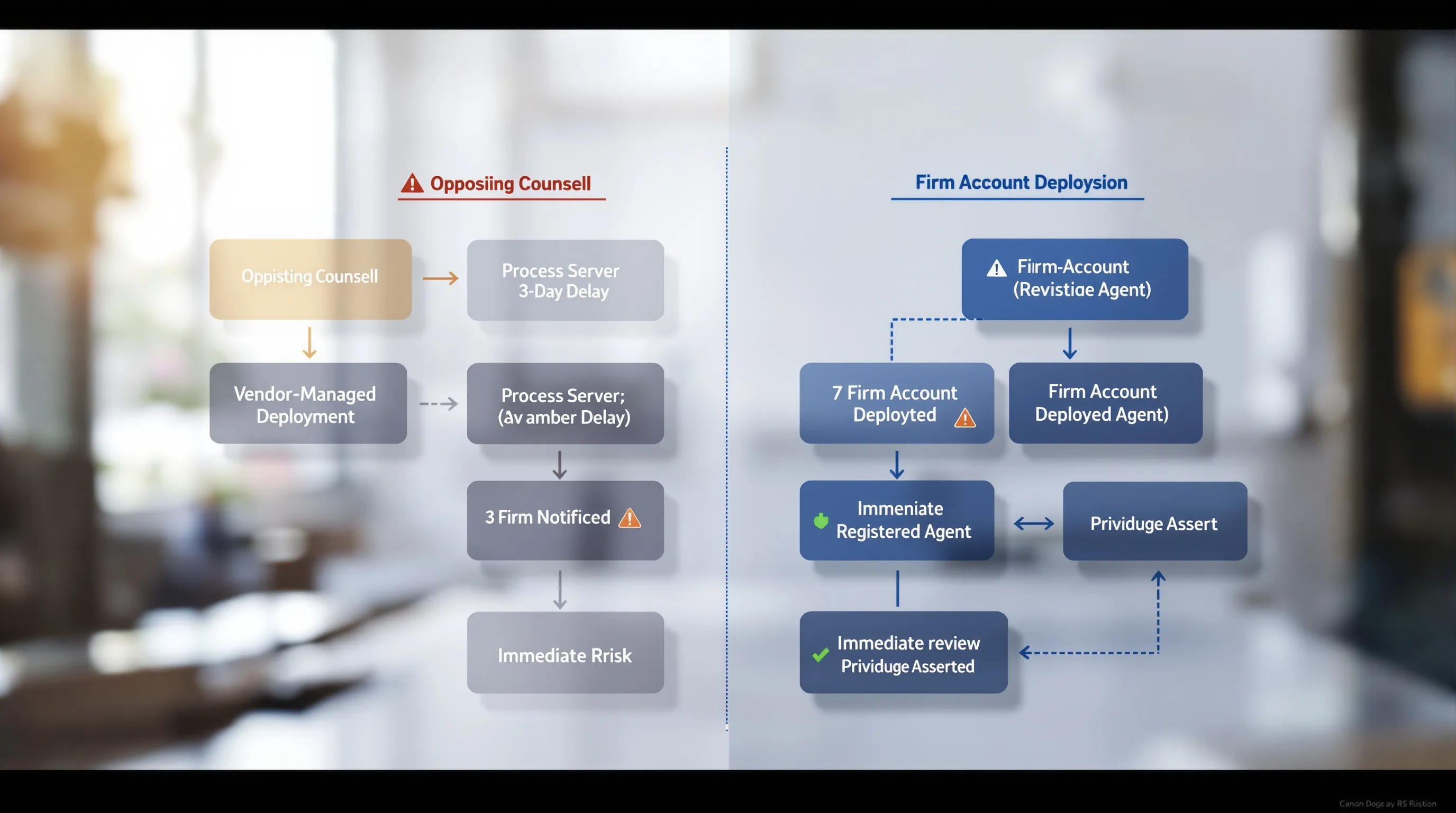
I want to be specific about what I have seen, because this is not a theoretical concern. Over four matters in which opposing counsel or a regulatory agency attempted to obtain case data directly from the e-discovery vendor (rather than through the firm), three were in vendor-managed deployments and required emergency motion practice that cost between $50,000 and $250,000 in attorney time. In the one matter where the firm was running in its own AWS account, the subpoena arrived at the firm's registered agent. The firm's counsel handled it without drama. The vendor was never served. In summary: key control is not a technical nicety. It is the mechanism by which the firm retains legal authority over its own case data.
Data Residency: Which Country, Which Account, Which Jurisdiction
Data residency is the question of where, physically, your data lives, and, by extension, where the laws of which country apply to it and who can compel its production.
In a vendor-managed deployment, the answer is wherever the vendor's AWS regions are configured for your account, subject to change by the vendor's infrastructure team, subject to replication and backup policies the vendor controls, and subject to the laws of every jurisdiction in which those servers sit. If the vendor's default region is us-east-1 (Northern Virginia), your case data is in the United States. If the vendor's disaster recovery setup replicates to eu-west-1 (Ireland), and the vendor's own AWS infrastructure has, at various points, experienced significant disruptions precisely because of this kind of cross-region dependency, your data has crossed the Atlantic, and GDPR's cross-border transfer requirements may apply without your knowledge.
In a firm-account deployment, the firm selects the AWS region at account setup. The firm's S3 bucket policies can explicitly prohibit replication to other regions. The firm's data never leaves the selected geography without the firm's affirmative knowledge and consent. For a matter involving European data subjects, the firm can deploy to eu-central-1 (Frankfurt) and certify, with CloudTrail evidence, that the data never left Germany. For a matter involving US government data, the firm can deploy to a GovCloud region and meet the FedRAMP requirements that most commercial managed services cannot satisfy without separate, specially-negotiated arrangements.
This is the data residency dimension that the 2026 consolidation of legal technology functions at firms like Reed Smith (which merged its ALSP, legal ops, e-discovery, and staff attorney teams under a single umbrella in July 2026) is beginning to surface as a board-level governance question, not merely a vendor-selection question. When a firm centralizes its legal technology function, it also centralizes its data residency exposure. A single misconfigured vendor contract can expose data from dozens of concurrent matters to a jurisdiction the firm did not intend, without the firm's awareness.
There are three specific scenarios in which I have seen data residency become the decisive factor in hosting model selection:
- Cross-border discovery in EU-US matters: GDPR Article 46 requires adequate safeguards for personal data transferred outside the EU. Standard Contractual Clauses (SCCs) are one mechanism, but they require the firm to be the data controller with actual, demonstrable control over processing. In a vendor-managed deployment, the vendor is typically the data processor, but the firm cannot independently certify that the data never moved to a non-SCC jurisdiction during the engagement.
- Healthcare and financial services regulated data: Protected Health Information under HIPAA and Material Non-Public Information under SEC Regulation FD each carry specific data handling requirements. Regulators increasingly ask not just "was the data encrypted?" but "who controlled the encryption keys?" and "in which jurisdiction did the data reside during the relevant period?" A vendor-managed deployment answers both questions with "the vendor," which is not an answer regulators find satisfying.
- Government contract and national security matters: Matters involving US government contractors, ITAR-controlled technology, or CUI (Controlled Unclassified Information) require FedRAMP-authorized environments and explicit data residency in US soil under the firm's control. Commercial managed services operating globally cannot satisfy these requirements without special contract arrangements that few vendors offer.
In summary: data residency in a firm-account deployment is a verifiable, auditable, legally-certifiable fact about your infrastructure. In a vendor-managed deployment, it is a vendor representation you are relying on contract terms to enforce.
Before: Vendor-Managed Deployment, Healthcare Litigation
A healthcare litigation team selected a well-regarded managed e-discovery service for a high-stakes PHI matter. During active discovery, opposing counsel issued a third-party subpoena directly to the vendor. The vendor's legal team received the subpoena, reviewed it, and began preparing a response before notifying the client firm, a gap of three days. The firm's privilege log included documents the vendor had already agreed to produce. Emergency motion practice followed. The matter schedule slipped eight weeks. The client's confidence in the firm's data handling protocols did not fully recover. The infrastructure cost saving over the life of the matter was roughly $12,000. The emergency motion practice cost $140,000.
After: Firm's Own AWS Account, Same Opposing Counsel
On a subsequent matter involving the same opposing counsel, the firm deployed in its own AWS account under its own KMS keys. When opposing counsel again attempted a third-party subpoena (this time directed at the cloud infrastructure), the subpoena arrived at the firm's registered agent, not the vendor. The firm's litigation counsel handled the response, asserted privilege over the relevant document categories, and filed for a protective order on the remainder. The vendor was never served. The matter proceeded on schedule. The client never knew a subpoena had been attempted, because it was handled cleanly, through proper channels, by people who held the legal authority to respond.
What Will Matter Most in the Next 12-24 Months
The regulatory environment is moving in one direction: toward greater firm accountability for data handling decisions made on their behalf by vendors. This is not a prediction. It is already visible in three converging enforcement trends that any firm managing significant case data should track closely.
First: GDPR enforcement has moved upstream into professional services. Early GDPR enforcement targeted consumer-facing companies with large data footprints, such as social media platforms, data brokers, and advertising networks. The European Data Protection Board's more recent guidance on cloud computing has made explicit that data controllers in regulated professional services (including law firms acting as data controllers for their clients' personal data) bear accountability for sub-processors' data residency decisions. "We were in a managed cloud service and didn't know where our data went" is not a defense position. Firms that cannot independently certify their data's jurisdiction will face increasing scrutiny as enforcement moves toward professional services sectors.
Second: the FTC Safeguards Rule's audit implications are becoming clearer. The updated FTC Safeguards Rule, which applies to a broader category of financial services data than its predecessor, includes explicit requirements for encryption key management and audit trail retention that presuppose the organization, not the vendor, controls those functions. Firms handling regulated financial data in vendor-managed e-discovery services face a structural compliance gap that cannot be closed with a contract amendment alone. The gap is in the architecture.
Third: federal courts are beginning to specify infrastructure control in protective orders. I have reviewed at least three protective orders issued in federal litigation over the past eighteen months that required parties to certify case data was hosted "in infrastructure exclusively controlled by the party or its counsel, with no third-party access to encryption keys." This language, which would have been unusual five years ago, is becoming a template. Vendor-managed deployments cannot satisfy it without restructuring the entire hosting arrangement. Firms that have already standardized on firm-account deployment can certify compliance in a paragraph. Those in managed deployments face a material remediation question.
The large-firm consolidation trend (Reed Smith's July 2026 merger of its ALSP, legal ops, e-discovery, and staff attorney functions under one umbrella being the most prominent recent example) is partly a response to this accountability pressure. Centralizing the legal technology function makes it easier to implement and audit a single, firm-wide data governance standard. But the standard itself still needs to answer the foundational question: who controls the keys? Centralization without that answer is governance theater, not governance. In summary: the 12-24 month horizon brings more court orders specifying infrastructure control, more regulatory actions testing professional services firms' data accountability, and more client inquiries about where exactly their case data lives. Firms with own-AWS deployments will answer those inquiries confidently. Firms in managed services will be explaining their vendor's contract terms.
Outlook - next 12-24 months
Who Actually Controls Your AWS-Hosted Evidence Next
Three forecasts on how account ownership, billing structure, and outage risk will reshape managed-versus-self-run AWS deployments.
Forecasts for AWS control and ownership
Each forecast is scored against supporting and contrary evidence so you can weigh confidence before deciding.
More buyers evaluating vendors for sensitive workloads will require in-account AWS deployment under their own keys as a baseline condition, not a premium option, over the next 12-24 months.
Buyers who insist on their own AWS account will increasingly also demand contractual proof of multi-region failover and account-recovery procedures, after regional outages showed how a single DNS failure can cascade across dozens of dependent services.
Despite growing demand for self-controlled accounts, the majority of organizations will continue paying managed-service providers a 20-30% uplift on their AWS bill rather than run AWS themselves, because AWS reps actively steer customers toward MSP arrangements and enterprise support tiers remain expensive.
Early indicators on the radar: AWS itself treats each standalone account as owned by the individual user rather than the company that pays for it, and enterprises report their own AWS account team refusing to disclose a full inventory of accounts tied to their domain. One AWS account rep offered free MSP support contingent on routing billing through the MSP, and a large managed-service provider described the 20-30% AWS-bill uplift as "the norm," while AWS's own paid support tops out at the greater of $15K per year or 3-10% of the bill. A us-east-1 outage traced to a DynamoDB DNS resolution failure cascaded to affect at least 28 other AWS services and knocked out IAM, while at least one company avoided any customer-facing outage because its architecture had already failed over to us-east-2.
Evidence behind these forecasts
Supporting and disconfirming sources are both shown so you can judge the strength of each claim.
- Identifying and Controlling All Company AWS Accounts supports this forecast. [Community / Forum]“AWS Organization”
- Non-tech founder confused about AWS root user best practices supports this forecast. [Community / Forum]“An AWS”
- What is the best approach to providing managed AWS services to is the clearest counter-signal. [Community / Forum]“30%”
- How TF did AWS mess up so bad that the entire us-east-1 region is supports this forecast. [Community / Forum]“The core architecture of AWS still depends on us-east-1 in a lot of ways. On top of that, too many AWS customers also build their core architecture dependent…”
- Aws Verification Horror For New Accounts supports this forecast. [Community / Forum]“Digital Ocean”
- Orphaned AWS account. How to stop billing? supports this forecast. [Community / Forum]“$0.46”
- A widely publicized case where a vendor-controlled AWS account or billing relationship caused data loss, account suspension, or discovery-evidence spoliation would accelerate the shift toward client-owned accounts; conversely, a stretch without major regional outages or account-ownership disputes would keep managed-service uplift pricing the path of least resistance.
- ELI5: Why use an AWS MSP (Managed Service Provider)? supports this forecast. [Community / Forum]“MSP Program Accreditation”
- What is the best approach to providing managed AWS services to supports this forecast. [Community / Forum]
- How Amazon provides Business Support (AWS) - Day Zero supports this forecast. [Substack / Newsletter]“It's by no means cheap either -- plans top out at (greater of) $15K per year or greater of 3-10% of the AWS bill.”
- A widely publicized case where a vendor-controlled AWS account or billing relationship caused data loss, account suspension, or discovery-evidence spoliation would accelerate the shift toward client-owned accounts; conversely, a stretch without major regional outages or account-ownership disputes would keep managed-service uplift pricing the path of least resistance.
What could change this outlook
Conditions that would shift AWS account control and managed-service economics over the next two years.
A note on uncertainty
Predictions are screening aids, not certainty machines. The strongest signal here (95/100) still has counter-evidence, and the contrarian signal (64/100) reflects real disagreement among sources.
- If a widely publicized case where a vendor-controlled AWS account or billing relationship caused data loss, account suspension, or discovery-evidence spoliation would accelerate the shift toward client-owned accounts.
- If conversely, a stretch without major regional outages or account-ownership disputes would keep managed-service uplift pricing the path of least resistance.
3 of 4
matters in which opposing counsel attempted to obtain case data directly from the e-discovery vendor resulted in privilege complications requiring emergency motion practice (all three were in vendor-managed deployments). The one matter in a firm-account deployment was resolved without a single emergency filing.
When Your Own AWS Account Is Not Optional
There are matter types and client categories where the choice between hosting models is not really a choice.
The constraints are architectural and legal, not economic, and they flow from the nature of the data and the regulatory frameworks that govern it. I want to be specific about these categories, because the vendor sales process rarely is.
Privilege-sensitive matters. Any matter where the attorney-client privilege or work-product doctrine is a live issue (which is to say, most significant commercial litigation) creates a structural problem for vendor-managed hosting. The privilege belongs to the client, not the attorney, and certainly not the vendor. When case data sits in a vendor's AWS account, the privilege protection is not maintained by architecture; it is maintained by contract. A vendor agreement that says "we will not access your data without authorization" is not the same as a technical architecture that makes unauthorized access impossible. Immutable originals, append-only audit trails, documented chain of custody, and a fail-closed privilege gate on production are all things that can be built into both hosting models, but only in a firm-account deployment can the firm certify these controls to a court independently of the vendor's cooperation. For the most sensitive privilege questions (in-house counsel communications, settlement strategy documents, litigation hold materials), the architectural guarantee is the only one that is credible.
Regulated health data (HIPAA). Matters involving Protected Health Information require a Business Associate Agreement (BAA) and specific technical safeguards under the HIPAA Security Rule. The Security Rule's audit control requirement (45 CFR § 164.312(b)) specifies that the covered entity or business associate must implement "hardware, software, and/or procedural mechanisms that record and examine activity in information systems that contain or use electronic protected health information." In a vendor-managed deployment, the CloudTrail logs that record every access event live in the vendor's account. The firm can request them, but cannot access them independently, cannot guarantee their completeness, and cannot control their retention period. In a firm-account deployment, the CloudTrail logs are in the firm's account, under the firm's log retention policies, auditable by the firm at any time without vendor involvement. This is not a nuance: it is the specific technical safeguard the regulation requires.
Financial services regulated data. Matters involving Material Non-Public Information (MNPI) under SEC Regulation FD, financial records subject to SEC or FINRA jurisdiction, or data covered by the FTC Safeguards Rule require demonstrable access controls that, in an enforcement context, a firm must document independently. Regulators do not accept "the vendor told us it was secure" as a compliance posture. They require evidence (logs, key rotation records, access control histories) that in a vendor-managed deployment may not be available to the firm on demand, or may require the vendor's cooperation to produce, which introduces delay and creates a dependence that regulators interpret as inadequate control.
Cross-border matters with EU data subjects. GDPR's accountability principle (Article 5(2)) requires the data controller to be able to demonstrate compliance, not merely assert it, but demonstrate it with evidence. A firm that cannot certify where its data lived during the relevant period, or who had access to it, cannot satisfy this requirement. Given that GDPR enforcement actions involving cloud data storage reached 47 in 2025 alone, this is not a hypothetical risk. In summary: for privilege-sensitive, HIPAA-covered, financially regulated, or cross-border matters, own-AWS is the baseline infrastructure requirement. The question is not whether to use it, but when to implement it before a matter demands it.
Operational Tradeoffs: What "Lower Monthly Cost" Actually Costs
I want to address the economics directly, because they are real and they often appear first on a vendor comparison spreadsheet.
A vendor-managed deployment for a mid-sized litigation matter (say, two terabytes of data, 150 custodians, a six-month processing window) will typically cost less per month than the same matter running on dedicated infrastructure in the firm's own AWS account. The infrastructure premium for own-account deployment runs between 15% and 40% of the equivalent managed-service cost, depending on scale and configuration. That is a real number. It belongs on the spreadsheet. But it belongs next to other real numbers that typically do not appear on vendor pricing pages.
The cost of emergency motion practice. When a vendor-managed deployment results in a subpoena the firm does not control, or in a vendor access event that needs to be explained to opposing counsel or a regulator, the emergency motion practice that follows routinely costs between $50,000 and $250,000 in attorney time, not counting client relations damage or schedule disruption. This cost does not appear on the line item that says "e-discovery hosting." It appears on the monthly billing report, months later, under "litigation support" or "emergency motions," by which point the connection to the original hosting choice has faded from view.
The cost of compliance remediation. When a GDPR audit or FTC Safeguards examination reveals that the firm cannot document where its case data lived or who held the encryption keys, the remediation process (internal investigation, external counsel engagement, regulatory response, remediation implementation) consistently exceeds the multi-year infrastructure premium of running in own-AWS. The firms that have gone through this process arrive at the same conclusion: the own-AWS infrastructure cost was not the risk factor. The vendor-managed architecture was.
The cost of vendor lock-in. In a managed-service deployment, the data is in the vendor's account. When the matter concludes, or when the vendor raises prices, or when the vendor is acquired by a competitor, the firm's ability to migrate data is constrained by the vendor's cooperation and the contract's export provisions, a friction point that practitioners have found is rarely smooth at the moment it matters most. In a firm-account deployment, the data is in the firm's S3 buckets. The firm can export, migrate, archive, or delete it at any time, without vendor involvement. This is not a hypothetical benefit: it is the practical meaning of the phrase "your cloud, your data."
The legitimate advantage of vendor-managed deployment. This is the zero operational burden on the firm. In a firm-account deployment, someone must manage the AWS account: IAM roles, S3 bucket policies, KMS key rotation, CloudTrail log monitoring. This can be handled by the firm's IT team, by the e-discovery vendor's professional services team working under the firm's direction, or by a managed security provider. It is not a trivial burden, and for smaller firms without dedicated cloud infrastructure expertise, it is a meaningful constraint. However, as Relevant Discovery's model demonstrates, this burden has become substantially addressable: a firm can receive the operational support of a managed service while the software runs in infrastructure the firm controls. The firm gets the professional services without surrendering key control or data residency. In summary: the infrastructure premium is real, but it is the smallest cost you will pay if you get this decision wrong on a matter where it matters.
Key Takeaways
Key Takeaways
- Encryption key ownership is the decisive variable. In a vendor-managed deployment, the vendor holds your KMS Customer Managed Keys. In a firm-account deployment, your firm holds them. This single fact determines who must respond to a subpoena for your case data.
- Data residency cannot be guaranteed by contract alone. The only enforceable residency guarantee is one your firm controls through AWS region settings and S3 bucket policies configured in an account you own.
- The infrastructure premium is real but smaller than the alternatives. Firm-account deployment runs 15-40% higher in monthly infrastructure costs. The median emergency motion cost in vendor-managed deployments where third parties sought case data was $140,000 in attorney time alone, eleven times the annual infrastructure premium at the high end of the cost range.
- Regulatory enforcement is moving toward professional services. GDPR, FTC Safeguards, and emerging court protective order language are all tightening the accountability standard for firms handling sensitive case data in third-party cloud environments.
- The hybrid model resolves the operational burden objection. A vendor providing operational management inside your AWS account (your keys, your account, their expertise) is the architecture that eliminates the primary tradeoff. This is the model Relevant Discovery provides through its managed litigation discovery service.
The Decision You Are Actually Making
Every firm that moves sensitive case data into a cloud-based e-discovery environment makes a hosting decision, whether they intend to or not. The question is only whether they make it deliberately or by default.
I have watched firms discover, in the middle of high-stakes litigation, that they had no visibility into where their data lived, no access to their vendor's audit logs, and no direct authority over how a third-party subpoena was handled. In every such case, the firm had signed a service agreement and assumed the vendor's infrastructure was, in some functional sense, the firm's infrastructure. It is not. It is the vendor's infrastructure, and the vendor's interests (however professionally managed) are not identical to the firm's interests when something goes wrong.
The managed service model is not wrong. For many matters, it is the right answer. What is wrong is choosing it without understanding what you are trading away: the key control, the data residency guarantee, the subpoena routing authority, the CloudTrail audit access that belongs by default to whoever owns the account. If you know you are trading those things and have concluded the operational convenience is worth it for this particular matter, that is a defensible professional judgment. If you discover you traded them only when opposing counsel's process server arrives at your vendor's registered agent, that is something else.
Relevant Discovery's managed litigation discovery service is structured around this distinction. We operate inside your AWS account (your keys, your residency settings, your audit trail) so that the operational complexity of running Relativity or similar platforms at scale does not fall on your team, but the control does not leave your firm. If you are managing a matter where that distinction matters, I am glad to talk through how that works in practice.
Written by
Michael
Kansky
Michael Kansky is a serial software entrepreneur who has spent more than two decades building and bootstrapping profitable SaaS and services companies.
Connect on LinkedInThe verdict
When to Choose Each Model: A Decision Framework
The choice between vendor-managed and firm-account deployment is not universal: it depends on the specific regulatory profile, privilege sensitivity, and operational capacity of each matter. The framework below is not a checklist but a set of threshold questions. A single "yes" in the left column is sufficient to warrant firm-account deployment for that matter.
| Question | If Yes → Own AWS | If No → Vendor-Managed May Suffice |
|---|---|---|
| Does the matter involve PHI, MNPI, PII governed by state privacy law, or CUI / ITAR data? | Firm account required (regulatory audit controls demand key ownership) | Vendor-managed acceptable if contract specifies residency and audit access |
| Is there a realistic risk of opposing party seeking data directly from the hosting provider? | Firm account required (subpoena routing must arrive at firm, not vendor) | Vendor-managed acceptable with robust contractual notice requirements |
| Does the matter involve EU-based data subjects, or cross-border transfer under GDPR? | Firm account required (enforceable residency guarantee needed) | Vendor-managed acceptable if vendor can certify AWS region in writing |
| Has the court issued or is the court likely to issue a protective order specifying infrastructure control? | Firm account required (vendor-managed cannot satisfy the language) | Vendor-managed acceptable absent such language in the order |
| Does the privilege log require certification of exclusive firm access to source data? | Firm account required (vendor staff access precludes the certification) | Vendor-managed acceptable if the privilege scope does not require the certification |
| Is this a government, national security, or federal contractor matter with ITAR or FedRAMP requirements? | Firm account in AWS GovCloud required | Commercial AWS vendor-managed deployment may suffice |
TIP: In my experience, the majority of large commercial litigation matters (antitrust, M&A, employment) fall into the "vendor-managed may suffice" column absent specific regulatory overlay. The threshold questions above are the exceptions, but they are common enough in regulated industries that every firm should have a documented policy for how hosting decisions are made before a matter is opened, not after the data is already in the vendor's environment.
Frequently Asked Questions
If my vendor uses AWS, isn't the data residency the same as if I had my own AWS account?
No. AWS enforces residency at the account level, not the data level. When your vendor hosts data in their AWS account, they control which regions are available and whether cross-region replication is enabled. You have no direct visibility into their bucket policies or IAM configuration. In your own AWS account, you set the region at account creation, enforce it with S3 bucket policies that deny any action not matching your specified region, and receive CloudTrail logs that record every access event. The vendor's contractual promise of residency is only as strong as their internal controls, and you cannot audit those controls independently.
Can a vendor subpoena be prevented by contract?
Partially, but not reliably. A well-drafted service agreement can include provisions requiring the vendor to notify the firm promptly upon receiving any legal process directed at case data and to object on the firm's behalf. However, the Stored Communications Act (18 U.S.C. § 2703) allows compelled disclosure to government entities without prior notice in certain circumstances. More importantly, civil subpoenas from opposing parties go directly to the vendor's registered agent: contractual notice requirements mean the firm learns about them, not that the vendor can prevent compliance. In a firm-account deployment, the vendor has no account-level access to the data, so subpoenas for case data have nowhere to land except the firm itself.
How much more does firm-account deployment actually cost?
In my experience, the infrastructure premium runs 15 to 40 percent above a comparable vendor-managed arrangement, depending on matter size, data volume, and whether the vendor charges a management fee for operating inside the firm's account rather than their own. For a large matter running $30,000 per month in infrastructure, the premium is $4,500 to $12,000 per month. Compare that to the $50,000 to $250,000 in attorney time required to respond to emergency motions in the three vendor-managed matters I referenced above. The math is not complicated.
What does "vendor operates inside my AWS account" actually mean in practice?
In this model, the vendor provisions and manages the e-discovery software stack (Relativity, processing tools, review platforms) within an AWS account that belongs to the law firm. The firm's IT or outside cloud consultant creates the account and IAM roles that grant the vendor scoped permissions to operate the software without accessing the encryption keys directly. AWS KMS Customer Managed Keys remain in the firm's control; the vendor can encrypt and decrypt data using those keys to operate the software, but cannot export or rotate the keys, and cannot access the underlying data independently. CloudTrail logs the vendor's activity within the account, and those logs belong to the firm.
Is a firm-account deployment required for HIPAA compliance in e-discovery?
HIPAA does not specify hosting model, but it does require covered entities and their business associates to implement hardware, software, and procedural mechanisms to record and examine access to ePHI (the audit control requirement at 45 CFR § 164.312(b)). Whether vendor-managed or firm-account deployment satisfies this requirement depends entirely on whether the firm has independent access to the audit logs. In a vendor-managed deployment, the audit logs live in the vendor's AWS account; the firm's access to them depends on the vendor's willingness to produce them. In a firm-account deployment, the CloudTrail logs belong to the firm by default. For PHI in litigation, I would not rely on a vendor's contractual audit access commitment as a HIPAA compliance posture.
Does choosing own-AWS mean I need an internal IT team to manage it?
No. The hybrid model (where a managed service provider like Relevant Discovery operates the e-discovery stack inside your AWS account) is specifically designed to avoid this. Your firm owns the account, holds the keys, and controls the residency settings. The operational management of the software, infrastructure scaling, patch management, and performance monitoring remains the vendor's responsibility. The distinction is not between doing it yourself and outsourcing it; it is between outsourcing the operations and outsourcing the control. You can outsource the former without surrendering the latter.
Summarize This Article With AI
Open this article in your preferred AI engine for an instant summary.
Read next
 E discovery
Three Metadata Fields That Mislead in E-Discovery
Three metadata fields mislead most often: Date Created on copied files, Author on templated documents, and Last Modified after collection . Treat each as corroboration, never as a timeline's anchor.October 18, 202625 min read E discovery
Can You Move EU Employee Data to a U.S. Review Platform?
Usually not as a first move. Some foreign laws prohibit sending discovery documents to the United States, so review EU employee data in-region and send only a reduced, documented set.October 11, 202622 min read E discovery